
If you have a court attendance notice with “Downing Centre” printed on it, you are not reading this out of curiosity. You have a date, a time, and most likely, a knot in your stomach. However, the day itself is more ordinary than most people expect: mostly waiting in a busy foyer, then a few minutes in front of a Judge. What goes wrong is almost always practical. The wrong building, arriving too late, or not knowing what to say when your name is called. This guide covers where the Downing Centre is, which matters are heard where in the complex, what happens on a first mention, what to wear and bring, whether you have to speak, how adjournments work, and what help is available on the day. Downing Centre Local Court at a glance (correct as at September 2026)
- Where: Local Court criminal matters sit on Level 4, Downing Centre, 143-147 Liverpool Street, Sydney, per the Local Court’s locations list.
- Not the same court: the District Court sits on Level 3 of the same building, and Local Court civil lists sit in John Maddison Tower on Goulburn Street.
- Start time: 9.30 am unless your notice says otherwise. Legal Aid NSW suggests arriving at least half an hour early.
- Registry: 9.00 am to 4.30 pm, Monday to Friday. Phone 1300 679 272.
- Do now: read the building name on your notice, check the online court list the day before, and get advice before you enter any plea.
Where is the Downing Centre, and how do you get there?
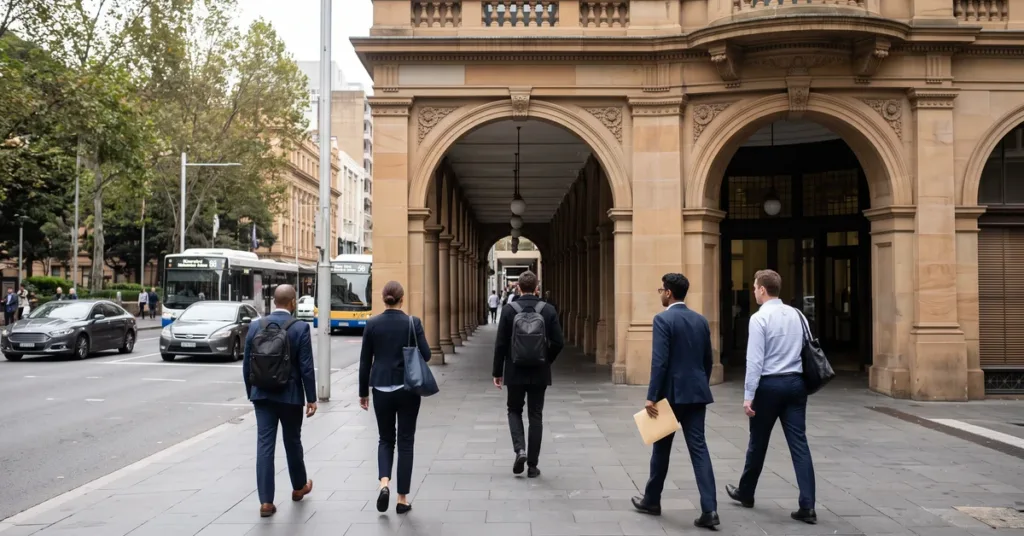
The Downing Centre is at 143-147 Liverpool Street, Sydney, between Elizabeth and Castlereagh Street. It is opposite the southern end of Hyde Park. It is a heritage building that was once a department store, which is why it looks nothing like a courthouse. Museum Station is the closest railway station, and Town Hall and Central are both a short walk. The court does not provide public parking and surrounding streets are metered and restricted, so public transport is the smart choice. One thing you need to know: the building closed for six months in 2025 after flooding, and much of the advice out there still reflects that period. According to NSW Courts and Tribunals, the Downing Centre reopened on 19 December 2025, with full Local Court operations resuming from 12 January 2026.
Local Court or District Court? The mistake that costs people a day
The Downing Centre houses more than one court, on different floors, and the adjoining John Maddison Tower is a separate building about a block away. Going to the right address but the wrong floor is the most common way people miss their own matter. Your court attendance notice names the court and the address, so read it rather than assuming.
| Where | Address | What sits there |
|---|---|---|
| Downing Centre, Level 4 | 143-147 Liverpool Street | Local Court criminal: mentions, pleas, defended hearings, sentences, AVO lists, traffic matters, bail |
| Downing Centre, Level 3 | 143-147 Liverpool Street | District Court criminal: trials, sentences, and appeals from the Local Court |
| John Maddison Tower | 86 Goulburn Street | Local Court civil lists, and the District Court civil registry |
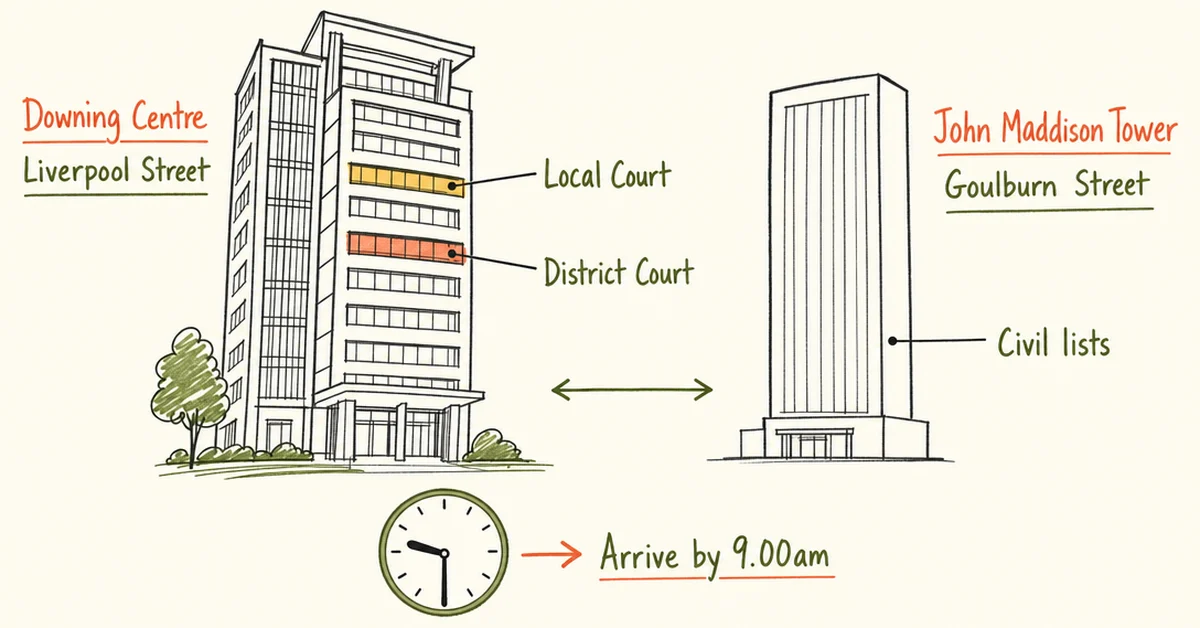
Two cautions. Local Court civil claims and criminal matters are not in the same place: the Sitting and Listing Arrangements for 2026 put Sydney CBD civil lists in John Maddison Tower and criminal lists at the Downing Centre. Civil work moved out of the Downing Centre years ago, so older directions to “Level 5” are out of date. The District Court’s location within the Downing Centre has changed more than once since the flooding. If your matter is in the District Court, check the online court list the day before and ring 1300 679 272 if there is any doubt. Which court you are in turns on how the offence is classified, which our guide to summary and indictable offences explains. Criminal lists run every weekday from 9.30am, with custody and bail lists daily and AVO lists on Wednesdays. Commonwealth matters such as federal fraud or tax offences are listed here too. If you are in custody seeking release, see our guide to bail applications in NSW.
What time should you arrive, and what should you bring?
Lists start at 9.30am: the Local Court’s published arrangements confirm that “unless otherwise stated, all starting times are 9:30 AM AEST”. Legal Aid NSW advises arriving at least half an hour early, so aim to be there by about 9.00am. That half hour is not padding:
- Security. There is airport-style screening, and queues can be long first thing.
- Finding your courtroom. The printed list in the foyer shows the case name and courtroom. If you cannot find your name, ask at the registry rather than guessing.
- Telling the Court Officer you are here. They usually wear a badge and move in and out calling names.
- Seeing a duty solicitor, who will get busy quickly.
What to wear: neat and tidy, not necessarily a suit. The Local Court’s guidance is that “you do not have to wear formal or business attire, however, you should aim to be neat and tidy.” Avoid singlets, thongs, sunglasses indoors and slogans. What to bring: your court attendance notice and any bail papers, photo identification, your solicitor’s contact details, and anything your lawyer has asked for, such as character references or medical evidence. Put your phone on silent: recording or photographing proceedings without permission is an offence. Then expect to wait. Your matter might be called at 9.35am or at 12.30pm, and the order is not published in advance, so take the whole day off.
What happens at a first mention, in order?
The first mention is short. No evidence is called and nobody decides whether the allegation is proved. It exists to work out what happens next. One naming change is worth knowing before you walk in. Since 28 March 2026, the magistrates in the NSW Local Court have been titled Judges of the Local Court instead of Magistrates, after the NSW Parliament changed the Local Court Act 2007. Their role, powers and procedure are unchanged, but many online sources still say “Magistrate”.
- Your name is called by the Court Officer.
- You go to the front, or your lawyer announces their appearance and you stay seated.
- The Judge asks what is happening. There are no juries in the Local Court, so a Judge decides alone.
- A plea is entered, or the matter is adjourned so you can get advice first.
- If you plead not guilty, directions are made for the prosecution to serve its evidence, and a hearing date follows later.
- If you plead guilty, you may be sentenced that day, or adjourned so material can be prepared.
- Bail is dealt with if it applies, and you get your next date in writing.
Most take two to ten minutes. Do not leave until you have the paperwork with your next date on it.
Do you have to speak, and what should you say?
If you have a lawyer, they speak and you do not. If you are on your own, you will need to say a few things, none of which require legal language. The Local Court’s own guidance is to stand whenever you speak and to “address the Judge as ‘your Honour'”. Beyond that:
- If you are ready to plead, say “guilty” or “not guilty” clearly. Nothing more is needed.
- If you are not ready, say “your Honour, I would like an adjournment to get legal advice before I enter a plea.”
- If you do not understand, say so. Judges deal with self-represented people every day.
Do not explain your side of the story at a mention. The Judge is not deciding anything on the facts, and everything said in court is on the record. Our fact sheets on pleading guilty and pleading not guilty set out what each choice commits you to.
Can you get an adjournment?
Usually yes, particularly at a first mention and particularly to get legal advice, but it is a request rather than an entitlement and the judicial officer must agree. NSW Courts and Tribunals guidance is explicit: if you are unsure how to plead, “you can ask the court to set another date so you can get legal advice before you enter a plea”. That is what asking for an adjournment means. What helps is asking early rather than after several previous adjournments, giving a real reason, and turning up in person. Do not simply stay away. If you do not attend and are not excused, the court can issue a warrant for your arrest and can deal with the matter in your absence. Some penalties, including imprisonment, cannot be imposed on someone who is not there, but a warrant is a serious problem to add to the one you already have.
Duty solicitor, your own lawyer, or neither?
A Legal Aid duty solicitor is free and available on the day, a private solicitor acts for you throughout, and representing yourself means you handle everything. Legal Aid duty solicitors appear on sitting days for first appearances, guilty pleas, mentions, adjournments and bail applications. No appointment is needed, but arrive early because they are frequently oversubscribed. Ask at the registry or look for the Legal Aid signage. Two limits are worth knowing. Legal Aid NSW says a duty lawyer “cannot represent you in court if you have pleaded ‘not guilty’ and your matter is listed for hearing that day”. Advice is available regardless of means, but if a duty lawyer is to represent you in court you will generally need to be eligible for legal aid. Your own solicitor can deal with the prosecution before the date, advise you on plea before you commit, and prepare material for sentence. Where a matter is likely to be defended, or your licence, job or liberty is at risk, this gives you the most control. Representing yourself is permitted. NSW Courts guidance is that “usually only a lawyer can represent a defendant at court or you can represent yourself”. You can bring a friend or family member as a support person, but if you want someone other than a lawyer to speak on your behalf you have to ask the judicial officer, and permission is not automatic.
Interpreters, accessibility and facilities
Interpreters are free in criminal matters and adjustments for disability are available, but both work far better arranged in advance. Interpreters. In criminal proceedings the court bears the cost. Contact the registry to arrange one, ideally at least a week ahead. If you are already in court, tell the judicial officer and one will be arranged for your next appearance. To phone the court through an interpreter, the free Translating and Interpreting Service is 131 450. Disability adjustments. NSW Courts and Tribunals provide infrared hearing loops, real-time captioning, Auslan interpreters at no cost in criminal and AVO matters, and documents in alternative formats. Notice periods matter: two weeks for a hearing loop, three weeks for captioning. Use the Request for Court Assistance form or ring 1300 679 272. Facilities. The 2025 refurbishment added new toilets, a parents’ room and a first aid room. Waiting areas are shared and busy, so if you need to speak privately with a lawyer, ask about an interview room rather than a corridor.
Your rights and what you can do now
You have real rights on a court date, and the steps below cost nothing. The most valuable thing is getting advice before you enter a plea, because a plea is hard to undo. Your rights:
- You are presumed innocent. The prosecution must prove the charge. You do not have to prove anything or explain yourself at a mention.
- You are entitled to legal advice, including free advice from a duty solicitor on the day.
- You can ask for time. An adjournment to get advice is granted routinely at a first mention.
- You can ask for an interpreter at no cost in a criminal matter.
Before your date:
- Check the building name on your notice, not just the suburb.
- Check the online court list the day before, and ring 1300 679 272 if anything is unclear.
- Take the whole day off work. If you are not there when your matter is called, the court may deal with it in your absence.
- Write down what happened while you remember it clearly, and keep it for your lawyer.
- Do not discuss the matter on social media or in messages to anyone else involved.
How a lawyer could help on your Downing Centre court date
A solicitor’s value on a mention day lies mostly in the work done before and around those few minutes in front of the Judge.
- Appearing for you, so you generally do not have to speak at all.
- Obtaining and reading the police brief, then advising on a plea based on what the evidence supports, not what is alleged.
- Negotiating with the prosecution. Written representations may result in a charge being withdrawn or reduced, or the agreed facts amended. Facts matter at sentence, and are often negotiable when the charge is not.
- Asking for the right adjournment, rather than one that only delays a worse outcome.
- Preparing a plea in mitigation. If you accept responsibility, character references, medical evidence and proof of counselling can be put before the court, and in appropriate cases a lawyer may argue for an outcome that avoids a conviction being recorded.
No lawyer can promise a particular result, and outcomes depend on the individual facts. What representation does is make sure the decisions taken on the day are informed ones.
Frequently asked questions
What time does Downing Centre Local Court start?
9.30 am. The Local Court’s published sitting arrangements state that, unless otherwise stated, all matters start at 9.30 am. Legal Aid NSW recommends arriving at least half an hour early, so aim to be there by about 9.00 am.
What floor is the Local Court on at the Downing Centre?
Level 4. The Local Court criminal registry and lists sit on Level 4 at 143-147 Liverpool Street. The District Court criminal jurisdiction sits on Level 3, and Local Court civil lists sit in John Maddison Tower.
Is the Downing Centre still closed?
No. It closed on 17 June 2025 after flooding from a burst water main and reopened on 19 December 2025, with full Local Court criminal operations resuming from 12 January 2026. Much online advice still describes the closure, so rely on the current court list.
What should I wear to Downing Centre Local Court?
Neat and tidy, not necessarily a suit. The Local Court’s guidance is that formal or business attire is not required but you should aim to be neat and tidy.
Do I have to speak in court?
Not if you have a lawyer. Your solicitor announces their appearance and speaks for you. If you represent yourself, you will need to give your plea or ask for an adjournment, standing when you speak and addressing the Judge as “your Honour”.
Is it a Magistrate or a Judge at the Local Court?
A Judge. Since 28 March 2026, NSW Local Court Magistrates have been titled Judges of the Local Court under an amendment to the Local Court Act 2007. What they can do and how the court runs have not changed, and you still address them as “Your Honour”.
Can I get my matter adjourned on the first day?
Usually, yes. Asking for an adjournment to get legal advice before entering a plea is routine at a first mention, but it remains a request the judicial officer must agree to.
What happens if I do not go to court?
The court can issue a warrant for your arrest, and the matter can be dealt with in your absence. If you genuinely cannot attend, contact the registry and get legal advice immediately.
How O’Brien Criminal & Civil Solicitors can help
A first mention is short, but the decisions taken in those few minutes, particularly how you plead, shape everything that follows. O’Brien Criminal & Civil Solicitors is a criminal defence firm led by an Accredited Specialist in Criminal Law, a credential awarded by the Law Society of NSW to a small minority of solicitors, with more than 20 years defending clients in Sydney’s criminal courts. We obtain and review the police brief, negotiate with the prosecution where the evidence allows, and prepare the strongest available case at sentence. Most usefully, we can tell you beforehand what is realistically likely to happen.
Request initial advice (no-obligation) via the form below or call us on (02) 9261 4281.
You can read more about how we run these matters on our criminal defence services page.
This content is for general information purposes only and does not constitute legal advice. You should seek independent legal advice relevant to your specific circumstances.