
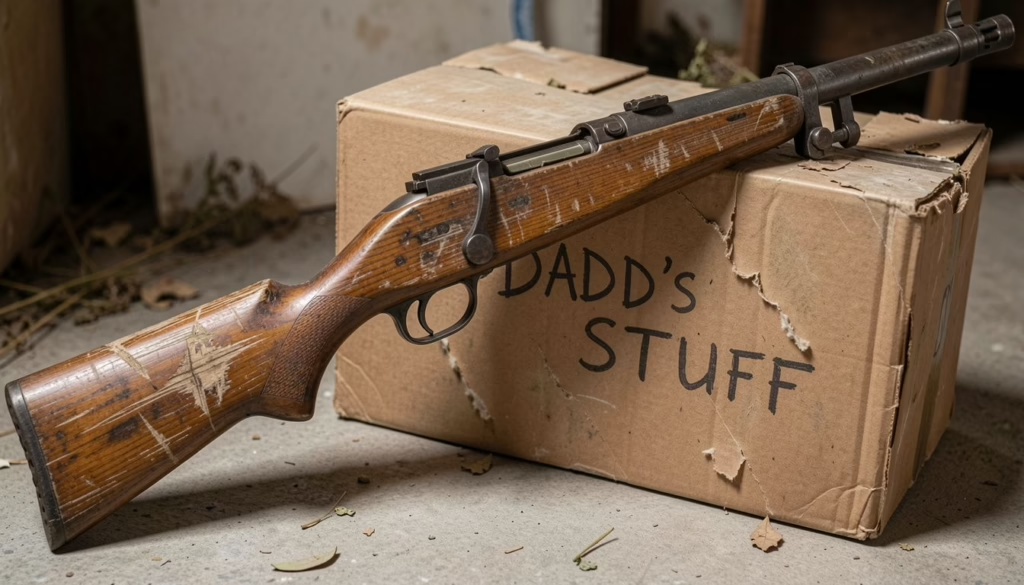
Illegal firearm possession charges don’t always involve obvious criminal activity. Sometimes they come from situations people don’t expect: firearms inherited from a family member that were never properly registered, licences that expired without the holder realising, firearms brought from interstate without registration in New South Wales, or temporary possession of a weapon found in a shared property.
Whatever the circumstances, the consequences of illegal firearm possession are serious. NSW has some of Australia’s strictest firearms laws, with criminal penalties that include Standard Non-Parole Periods, guideposts for minimum prison terms for certain offences. The category of firearm, whether it was registered, and whether you held a valid licence all affect the charges and likely penalties you face.
This factsheet explains the different types of illegal firearm possession offences in NSW, what prohibited firearms and prohibited weapons are, how Standard Non-Parole Periods work, the legal defences that may be available, and what may happen to your licence if you are charged.
Read our successful Criminal Case Studies.
Key Takeaways
- NSW firearms and weapons offences are prosecuted under the Firearms Act 1996 (NSW) and the Weapons Prohibition Act 1998 (NSW).
- Maximum penalties vary significantly depending on the offence, the category of firearm, and the circumstances, ranging from 5 years for some unlawful possession offences up to 20 years for the most serious aggravated prohibited firearm offences.
- Standard Non-Parole Periods (SNPPs) apply to certain serious offences as a legislative guidepost, they indicate the non-parole period courts should generally impose for a mid-range offence, but are not inflexible minimums in every case.
- Prohibited firearms and military style weapons attract the most severe criminal penalties under NSW law.
- Several legal defences may be available, including temporary possession for a lawful purpose, lack of knowledge or control, mistaken identity, and in some circumstances, reasonable excuse or lawful excuse.
- NSW has a firearms surrender scheme that may allow voluntary surrender without prosecution in certain circumstances, but expert legal advice should be obtained before relying on this.
- O’Brien Criminal & Civil Solicitors have extensive experience defending all categories of NSW firearms related charges.
Act Quickly If You Are
- Charged with unauthorised possession or use of an unregistered, unlicensed, or prohibited firearm
- Subject to a police search warrant in connection with a firearms or weapons offence
- Holding a firearm or firearm part that has been inherited, found, or left in your property
- Aware that your firearms licence has lapsed while you still possess firearms
- Subject to a firearms prohibition order or facing licence suspension or revocation
Do not make any statement to police before speaking to a lawyer prior to any interview. Call O’Brien Criminal & Civil Solicitors on 02 9261 4281 immediately.
Types of Illegal Possession Offences in NSW
The seriousness of any criminal charges depends on the category of firearm, whether it is registered, and whether you hold a valid licence. The following table provides a general guide, the exact maximum penalty and applicable SNPP for any specific charge should be verified against the current legislation.
| Offence | Maximum Penalty | Standard Non-Parole Period |
|---|---|---|
| Unauthorised possession of prohibited firearm (s7) | 14 years imprisonment | 4 years |
| Unauthorised possession of pistol or prohibited firearm: aggravated (s7A) | 20 years imprisonment | 10 years |
| Unauthorised possession of unregistered firearm (s36) | 5 years imprisonment | None |
| Possession or use of firearm without licence (s7) | 5 years imprisonment | None |
| Possession of shortened firearm (s4A Weapons Prohibition Act) | 14 years imprisonment | 3 years |
| Possession of unregistered or prohibited firearm in company (s93G Crimes Act) | 10 years imprisonment | 3 years |
Less serious matters may be finalised in the Local Court, while substantive offences carrying higher maximum penalties are typically dealt with in the District Court. Where the matter is heard affects the sentencing procedure available and the maximum sentence the court can impose.
What Are Standard Non-Parole Periods?
Standard Non-Parole Periods (SNPPs) are legislative guideposts set by Parliament for certain serious firearms-related charges. When a court sentences a person for an offence with an SNPP, the non-parole period, the minimum time in custody before parole eligibility, should generally reflect the SNPP for a mid-range offence of that type. Courts can and do depart from the SNPP where the offence is more or less serious than the mid-range, or where strong mitigating or aggravating factors apply.
For example, the unauthorised possession of a prohibited firearm carries a 4-year SNPP. For a mid-range example of that offence, a court would ordinarily set a non-parole period in that range. The total sentence will typically be longer, but the SNPP provides a reference point for where courts should generally begin. SNPPs are not a rigid floor from which courts cannot depart, they are a guidepost that reflects the seriousness Parliament attaches to these offences.
Prohibited Firearms and Prohibited Weapons in NSW
Prohibited firearms attract the most severe criminal penalties under NSW law. These are firearms considered too dangerous for civilian gun ownership in any circumstances.
Under Schedule 1 of the Weapons Prohibition Act 1998, prohibited firearms include machine guns and automatic firearms capable of continuous fire, certain semi automatic and self-loading rifles and shotguns exceeding specified magazine capacities, shortened firearms with barrels reduced below legal length, certain handguns below minimum barrel or overall length or above specified calibres, firearms disguised as other objects, rocket launchers and grenade launchers, and improvised or home-made firearms including those produced by 3D printing.
The precise definitions of these specific weapons are set out in the legislation and should be verified against the current Schedule.
Separate prohibited weapons offences are dealt with under the Weapons Prohibition Act 1998, which covers items beyond firearms entirely, including spear guns in certain circumstances, flick knives, and a range of other prohibited items. Possession of these items without a permit is a serious criminal offence, with severe criminal penalties depending on the item involved.
Even an air gun may, in certain circumstances and depending on its specifications, fall within regulation under firearms or weapons legislation. If you are unsure whether something you possess is a prohibited weapon or a firearm part, expert legal advice should be obtained before any approach to authorities.
Aggravated Prohibited Firearm Offences
Section 7A of the Firearms Act 1996 creates an aggravated offence carrying a higher maximum penalty of 20 years imprisonment and a 10-year SNPP where you possess a prohibited firearm or pistol in specified aggravating circumstances. These include the firearm being loaded, possessing ammunition for the firearm, possessing multiple firearms, possessing the firearm in company with others, or possessing it in circumstances involving aggravated violence.
The specific elements of this aggravated offence involving a prohibited firearm should be carefully reviewed against the current statutory text in any individual case.
Registration and Licensing Requirements
Registration
NSW law requires firearms to be registered with the NSW Firearms Registry. Possessing an unauthorised firearm that is not registered in accordance with the Act’s requirements may constitute a separate offence under the Firearms Act 1996. The requirements around registration, including any exceptions or transitional provisions that may apply in particular circumstances, are set out in the legislation.
When acquiring a firearm in NSW, the general requirements include holding an appropriate licence or permit for that category, obtaining a Permit to Acquire from NSW Police, and registering the firearm with the Firearms Registry within the required period following acquisition. The specific requirements and any exceptions should be confirmed against current NSW Police guidance and the legislation.
Common situations that lead to charges involving an unauthorised firearm include inheriting a firearm from a deceased estate and failing to register or surrender it, purchasing a firearm interstate and bringing it to NSW without NSW registration, acquiring a firearm privately without a proper Permit to Acquire, and losing track of registration obligations after moving address. In some matters, a person may also face additional charges where the firearm is alleged to be among stolen firearms recorded in police databases, even where the person had no knowledge of its provenance.
Licence Categories
To legally possess a firearm in NSW, you must hold a current licence in the appropriate category. NSW licence categories include Category A (rimfire rifles, air rifles, shotguns that are not self-loading), Category B (centrefire rifles, muzzle-loading firearms), Category C (self-loading rimfire rifles, pump-action shotguns, restricted availability), Category D (self-loading centrefire rifles and certain shotguns, very restricted, available only where an authority exists for specific purposes such as certain professional uses), and Category H (pistols and revolvers, requires active membership and regular participation in an approved pistol club).
Each category requires demonstrating a genuine reason for possession, such as sport shooting, primary production, pest control, or firearms collecting. The precise eligibility criteria for each category should be confirmed with NSW Police or a legal adviser.
Licence Renewal and Expiry
Firearms licences have renewal requirements that vary depending on the licence type and conditions. Possessing a firearm while your licence is expired or not current may constitute an offence. If your licence has expired or lapsed, it is important to seek expert legal advice promptly, the options available to you will depend on the circumstances and how much time has passed since expiry.
Firearms Prohibition Orders
NSW Police can issue a firearms prohibition order against a person who, in the Commissioner’s view, is not fit to have possession of a firearm. A firearms prohibition order has significant ongoing consequences. It prohibits the person from possessing or using firearms, firearm parts, or ammunition, and grants police broad powers to search the person, their vehicle, or premises they occupy without a warrant. Possession use of a firearm in breach of a firearms prohibition order is a serious criminal offence in its own right. If you have been served with a firearms prohibition order, or are facing charges for breaching one, legal advice is important.
Defences
There are several legal defences that may be available to firearms related charges, depending on the facts. The defences below are the most common, but the right approach depends on the circumstances of your matter.
Temporary Possession for a Lawful Purpose
NSW law recognises circumstances in which temporary possession of a firearm without the usual lawful authority may be lawful, provided the possession was for a genuine lawful purpose and prompt, reasonable steps were taken to dispose of or report the firearm. This might apply where you found a firearm and were taking it directly to police, or where you discovered an inherited firearm and were making immediate arrangements to surrender it. This is a fact-specific exception, the circumstances, the steps taken, and the time elapsed are all relevant to whether it applies. Holding a firearm for an extended period without taking steps significantly undermines the argument.
Lack of Knowledge or Control
If you did not know the firearm was present or did not have control over it, the prosecution cannot establish possession. This may apply where police found a firearm in shared premises you do not control, the firearm was in a vehicle in which you were merely a passenger, or someone placed a firearm in your property without your knowledge. Each of these situations will require a careful factual analysis.
Mistaken Identity
In some matters, the question is not whether possession occurred but whether the person charged is the person responsible. Where multiple people had access to premises or a vehicle, or where identification evidence is weak, it may be possible to argue that the wrong person has been wrongly identified. Establishing mistaken identity requires careful examination of the prosecution evidence, including any forensic evidence, surveillance, and witness accounts.
Reasonable Excuse or Lawful Excuse
In limited circumstances, a genuine reasonable excuse or lawful excuse for possessing a firearm without proper authority may be available as a defence. This is a high bar and requires genuine, non-criminal reasons assessed against the specific facts.
Firearms Surrender
NSW has a firearms surrender scheme under which a person may be able to surrender an unlicensed or unwanted firearm to police without prosecution, depending on the circumstances. National campaign-style amnesties have also operated periodically, allowing voluntary surrender outside the usual prosecution framework. If you believe you may be holding a firearm without proper authority, seek expert legal advice before taking any steps, the availability of any protection under the surrender scheme will depend on whether and how any investigation has already commenced.
Real-World Scenarios
Scenario 1: The Inherited Firearm
A person’s parent passes away, leaving a firearm in the family home. The person is unaware of the registration and surrender requirements and holds the firearm for several months while managing the estate. They are subsequently charged with an offence involving possession of an unregistered firearm. Their lawyer raises the temporary possession defence, supported by evidence that they were managing the estate and had no intent to use or supply the weapon. The strength of this defence and the prospect of a favourable outcome depends significantly on the steps taken and the time elapsed.
Scenario 2: The Lapsed Licence
A farmer holds a Category B firearms licence for many years. Their licence expires and, amid the demands of running the property, they fail to renew it before continuing to possess their firearms. A routine check reveals the lapsed licence. Their lawyer makes submissions addressing the circumstances, the person’s prior compliance history, good character, and the inadvertent nature of the oversight. The outcome will depend on the specific facts, including how long the licence had lapsed and what steps were taken once the person became aware.
Scenario 3: Shared Premises
Police execute a search warrant at a shared house and discover an unregistered firearm in a communal area. Multiple occupants are initially under investigation. The question of who had knowledge of and control over the firearm is central, and an unauthorised person may be wrongly identified as the possessor where the evidence is unclear. The prosecution must establish possession against a specific individual, a defended hearing may be required to resolve the factual dispute.
Licence Consequences Following Charges or Conviction
NSW Police have powers under the Firearms Act 1996 to suspend or revoke a firearms licence in various circumstances, including following a charge or conviction for a serious criminal offence involving firearms and weapons. The specific consequences, including whether a suspension or revocation occurs, and for how long, depend on the offence, the statutory provisions engaged, and the circumstances of the case.
A conviction for a serious firearms offence can result in significant restrictions on a person’s ability to hold a firearms licence going forward, particularly where the conviction involves a prohibited firearm, firearms trafficking, or other offences related to organised criminal conduct. The nature and duration of any prohibition depends on the offence and the applicable legislative provisions. Lengthy terms of disqualification can apply in serious cases. Expert legal advice specific to your situation is important to understand the licence consequences you may face.
Licence consequences can have a significant practical impact on farmers, sport shooters, and collectors. If your licence has been suspended following a charge, seeking legal advice promptly may assist in understanding your options.
Frequently Asked Questions
What is the penalty for possessing an unregistered firearm in NSW?
The maximum penalty under section 36 of the Firearms Act 1996 is 5 years imprisonment. There is no Standard Non-Parole Period, so outcomes vary based on the specific circumstances. The actual sentence will depend on the nature of the firearm, the circumstances of possession, the person’s history, and the strength of any mitigating submissions. Expert legal advice specific to your situation is important.
What makes a prohibited firearm different from other firearms?
A prohibited firearm is one listed in Schedule 1 of the Weapons Prohibition Act 1998 — automatic and military style weapons, certain semi automatic and self-loading firearms, shortened firearms, disguised firearms, and others considered too dangerous for any civilian purpose. Possessing a prohibited firearm carries a maximum of 14 years (or 20 years in the most serious aggravated circumstances), significantly higher than the 5-year maximum for unlicensed possession of a non-prohibited firearm. The specific category and nature of the firearm is often the single most important factor in determining the severity of the charge.
Can I be charged if I found a gun and was taking it to police?
Temporary possession for a lawful purpose may be available as a defence, but it is fact-specific. It requires evidence of prompt, reasonable steps to report or surrender the firearm. Calling police immediately or driving directly to a police station supports the defence. Holding the firearm without taking such steps, or holding it for an extended period, significantly weakens the argument.
What is the firearms surrender scheme and can I use it?
NSW has a scheme under which a person may be able to surrender an unlicensed or unwanted firearm to police without prosecution in certain circumstances. However, whether that protection is available depends on the specific situation and whether any investigation has commenced. Do not rely on the surrender scheme without first obtaining legal advice.
What happens to my licence if I am charged?
NSW Police have powers to suspend a licence in various circumstances following a charge. The precise consequences depend on the offence, the statutory provisions engaged, and the circumstances. If your licence has been suspended, seeking legal advice promptly is important.
Why are NSW firearms laws so strict?
NSW firearms laws operate within a national framework that was substantially tightened following the Port Arthur massacre in 1996, which led to the National Firearms Agreement and significant changes to gun ownership rules across Australia. The framework reflects a strong public safety rationale, particularly for prohibited firearms, military style weapons, and firearms trafficking, which carry the most serious criminal penalties.
How O’Brien Criminal & Civil Solicitors Can Help
O’Brien Criminal & Civil Solicitors have extensive experience defending the full range of NSW firearms and weapons offences, from unregistered firearm and licensing matters through to prohibited firearms charges and prohibited weapons offences carrying maximum penalties of 14 to 20 years imprisonment.
We understand the technical requirements of NSW firearms law, the legal defences available, and how to negotiate with police prosecutors to achieve charge reductions or alternative outcomes where the circumstances support it. Whether you are facing criminal charges, have had your licence suspended, are subject to a firearms prohibition order, or need urgent advice about your situation, we provide strategic and experienced representation.
Call O’Brien Criminal & Civil Solicitors on 02 9261 4281 or enquire online for a confidential consultation.