

Being charged with serious drug supply offences in New South Wales, what most people call “drug trafficking”, is one of the most serious criminal matters you can face.
However, unlike simple possession, commercial drug supply charges carry severe penalties, with some large commercial quantity offences carrying a maximum of life imprisonment. If you’ve been arrested or are under investigation for drug trafficking, understanding the charges and your legal rights from the outset is critical.
The following guide explains what drug supply offences actually involve under NSW law, the quantity thresholds that determine charge severity, maximum penalties, bail considerations, available defences, and why getting an experienced criminal lawyer on board early is so important.
What Is “Drug Trafficking” Under New South Wales Law?
This is one of the most important things to understand: NSW law does not have a separate offence called “drug trafficking.” What people commonly refer to as drug trafficking is prosecuted as drug supply under the Drug Misuse and Trafficking Act 1985, specifically as commercial or large commercial quantity supply.
The term “trafficking” is widely used in everyday language, by police, and in media reporting, but when you receive a charge document, it will refer to supply offences, not trafficking as a standalone charge. Understanding this distinction matters for how you approach your defence.
Drug supply offences in NSW are governed by the Drug Misuse and Trafficking Act 1985 (NSW), which distinguishes between different levels of offending based on the type and quantity of drugs involved.
The Act criminalises supplying prohibited drugs, and supplying drugs on an ongoing basis, meaning repeated acts of supply over a period of time, is treated as a particularly serious offence due to its organised and persistent nature. The difference between a traffickable quantity and a commercial quantity can have an enormous impact on the penalties you face.
Large-scale drug supply investigations in NSW are often conducted by the NSW Police Force, sometimes in joint investigations with the Australian Federal Police, Australian Border Force, or even international agencies such as the New Zealand Police, New Zealand Customs, or Canadian authorities.
These matters frequently involve allegations of links to organised crime networks, cross-border importation of a border controlled drug under the Criminal Code (Cth), and complex supply chain operations stretching across Australia and overseas.
Supplying Prohibited Drugs vs Possession: What’s the Difference in NSW?
Drug Possession: Having drugs in your custody or control for personal use. Lower penalties apply for drug misuse, though possessing a traffickable quantity triggers a legal presumption, known as “deemed supply”, that you intended to supply the drugs to others. This presumption is rebuttable and can be challenged in court.
Drug Supply: Providing, distributing, or selling drugs to another person, regardless of quantity. This includes giving drugs away for free, there is no requirement for financial gain. It’s worth noting that supply can also be charged under Section 25A of the Act as “ongoing supply”, a serious offence that can apply even where the quantities don’t reach commercial thresholds.
Commercial and Large Commercial Supply (Drug Trafficking): Large-scale supply involving commercial or large commercial quantities. These charges signal serious organised criminal activity and attract the harshest penalties under NSW law.
Understanding Drug Quantities: Traffickable, Commercial Quantity, and Large Commercial
The severity of drug supply charges in NSW depends heavily on the quantity of drugs involved. Schedule 1 of the Drug Misuse and Trafficking Act sets out five quantity categories:
- Small quantity: Minor possession offences
- Traffickable quantity: At or above this threshold, you can be charged with “deemed supply”, though this presumption can be challenged
- Indictable quantity: More serious supply offences
- Commercial quantity: Large-scale supply, attracting up to 20 years maximum (or 15 years for cannabis leaf)
- Large commercial quantity: The most serious category; some offences carry life imprisonment (or 20 years for cannabis leaf)
Drug Quantity Thresholds and Maximum Penalties
The table below shows quantity thresholds for common drugs. Note that thresholds are generally expressed in total weight (including admixture) and that different forms of cannabis (leaf, plant, resin, oil) have separate thresholds.
You should always confirm current figures against Schedule 1 of the Act before relying on them, as these can be amended.
| Drug Type | Traffickable | Commercial | Large Commercial | Max Penalty (Large Commercial) |
|---|---|---|---|---|
| Cannabis Leaf | 300g | 25kg | 100kg | 20 years |
| Cocaine | 3g | 250g | 1kg | Life |
| Methamphetamine (Ice) | 3g | 250g | 500g | Life |
| MDMA (Ecstasy) | 3g | 250g | 1kg | Life |
| Heroin | 3g | 250g | 1kg | Life |
Note: The above figures relate to cannabis leaf specifically. Other cannabis forms (plant, resin, oil) carry different thresholds. Cannabis leaf offences are also excluded from the standard non-parole period provisions discussed below.
Maximum Penalties for Commercial Drug Supply in NSW
Drug supply charges at commercial and large commercial levels carry some of the harshest penalties in Australian criminal law. Section 25 of the Drug Misuse and Trafficking Act creates the supply offences, with maximum penalties prescribed in sections 33 and 33AA of the Act and explained in the NSW Judicial Commission’s Sentencing Bench Book:
- Commercial quantity supply: Maximum 20 years imprisonment and/or a fine of 3,500 penalty units for most drugs (15 years for cannabis leaf)
- Large commercial quantity supply: Maximum life imprisonment and/or a fine of 5,000 penalty units for most drugs (20 years for cannabis leaf)
Penalty units are updated periodically, at the current rate these equate to approximately $385,000 and $550,000 respectively, though you should confirm the current penalty unit value with your lawyer.
Standard Non-Parole Periods
For certain commercial and large commercial supply offences under s 25(2) involving drugs other than cannabis leaf, NSW law imposes standard non-parole periods, minimum prison terms that must be served before eligibility for parole:
- 10 years for commercial quantity supply
- 15 years for large commercial quantity supply
Standard non-parole periods do not apply where the offence concerns cannabis leaf.
These figures represent the starting point for sentencing. Courts can impose shorter or longer non-parole periods based on mitigating or aggravating factors, but they demonstrate how seriously these offences are treated.
Can You Get Bail for Drug Supply Charges?
Yes, you can get bail in NSW for drug supply charges.
However, bail for commercial drug supply charges is often difficult to obtain, particularly where the alleged role is significant, though outcomes depend heavily on individual circumstances.
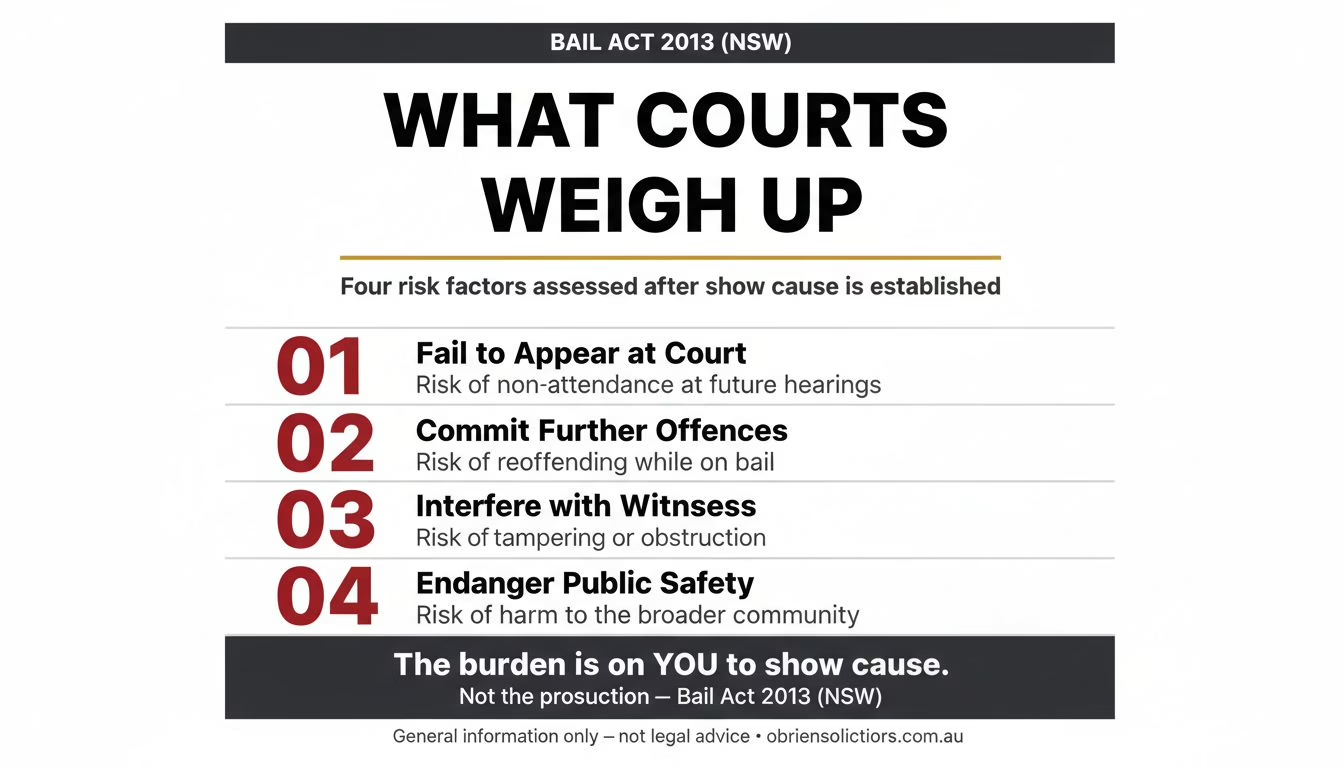
Offences involving a commercial quantity of a prohibited drug are classified as show cause offences under the Bail Act 2013 (NSW). This means your lawyers bear the onus of showing the court why your continued detention is not justified. The prosecution will still typically make submissions on risk and conditions, but the burden falls on your defence rather than on them to argue for remand.
Factors Courts Consider
If you successfully show cause, the court must then assess whether there is an unacceptable risk that you will:
- Fail to appear at court
- Commit further offences while on bail
- Interfere with witnesses or evidence
- Endanger public safety
Evidence such as strong community ties, stable accommodation, employment history, and financial sureties can help support your bail application. Where bail is refused in the Local Court, you can apply to the Supreme Court.
Facing drug supply charges and need urgent advice? Our criminal defence team has successfully defended clients charged with serious drug offences across NSW. We understand what’s at stake and will fight hard to protect your rights. Call us on 02 9261 4281 or request a free consultation using the form below.
Defences Available for Drug Supply Charges
Being charged with drug supply does not mean you’ll definitely be convicted. Depending on the circumstances, several defences are available to you. For example:
1. Lack of Knowledge
If you genuinely didn’t know drugs were in your possession or control, this may be a valid defence. It arises most commonly where:
- Someone else had access to your property or vehicle
- Drugs were concealed without your knowledge
- You were asked to transport something without knowing the contents
The prosecution must prove beyond reasonable doubt that you knew the drugs were present and that they were prohibited drugs. It’s worth noting that recklessness or “wilful blindness”, deliberately avoiding knowledge of what you’re carrying, can also satisfy the mental element, so this defence needs careful assessment with your lawyer.
2. Duress
If you were coerced or threatened into involvement with drugs, duress may be available as a defence. To succeed, you generally need to show:
- You faced a threat of serious harm
- The threat was immediate and continuing
- You had no reasonable way to escape or avoid the situation
- A person of ordinary firmness would have done the same in the circumstances
Duress requires strong corroborating evidence and should be raised with your lawyer as early as possible.
3. Challenging the Quantity
As penalties escalate based on weight thresholds, how the drugs were weighed and classified can be pivotal. Issues may include:
- Incorrect weighing procedures
- Packaging or cutting agents being included in the weight
- Errors in calculating pure drug content
Expert forensic analysis may establish that the quantity falls below a commercial threshold, which can result in significantly reduced charges and penalties.
4. Police Procedural Errors
If the police conducted an unlawful search, failed to follow proper arrest procedures, or obtained evidence improperly, a court may exclude that evidence under Section 138 of the Evidence Act 1995 (NSW). In some cases this can lead to charges being withdrawn or dismissed entirely.
5. Challenging Deemed Supply
If you’re charged with supply of drugs based solely on possessing a traffickable quantity, you may be able to argue the drugs were for personal use rather than supply. Evidence that may help rebut the presumption includes:
- No drug dealing paraphernalia (scales, deal bags, tick lists)
- A history of personal drug use
- No significant unexplained cash
- No communications suggesting supply activity
It’s important to understand that even if the deeming provision is successfully rebutted, the prosecution may still attempt to prove supply through other evidence, such as phone records or communications. Your lawyer will assess the full picture.
The Court Process for Drug Supply Offences
Commercial and large commercial quantity supply charges are strictly indictable offences, meaning they must ultimately be finalised in the District Court rather than the Local Court. Lower quantity supply offences can, in some circumstances, be dealt with summarily in the Local Court.
Typical Process
- Arrest and charging: You’re formally charged and may be held in custody pending a bail hearing.
- First appearance (Local Court): The matter is listed briefly before a Magistrate while the prosecution prepares the brief of evidence.
- Charge certification and case conference: Under the current NSW committal process, the prosecutor certifies the charges and a case conference takes place between the parties. Many matters are resolved or refined at this stage. Contested committal hearings are now limited to cases where leave is granted.
- Committal to District Court: If the matter proceeds, the Magistrate commits it to the District Court for trial or sentence.
- Arraignment: You formally enter a plea of guilty or not guilty in the District Court.
- Trial or sentence hearing: A not guilty plea proceeds to trial; a guilty plea moves to a sentencing hearing.
This process typically takes many months, sometimes well over a year. Early preparation makes a real difference to how the case unfolds.
Why Early Legal Representation Matters
The decisions made in the first 48 hours after arrest for drug supply can significantly shape the outcome of your case. Here’s why getting an experienced criminal defence lawyer involved immediately is so important:
Police interviews: You have the right to silence. Anything you say during police questioning can be used against you, even seemingly innocent explanations. A lawyer’s role at this stage isn’t just to advise you; it’s to make sure you don’t inadvertently give the prosecution something to work with.
Bail applications: A well-prepared bail application, with supporting documents, surety arrangements, and a clear plan, can be the difference between going home and spending months in custody.
Evidence and procedure: Early investigation can uncover unlawful searches, forensic errors, or procedural failures that may be used to challenge the prosecution’s case before trial.
Charge negotiation: Experienced lawyers can sometimes negotiate with prosecutors to reduce charges from commercial to lower-level supply, which can dramatically change the sentencing range you’re exposed to.
Sentencing preparation: If the matter does proceed to sentencing, early preparation, including character references, rehabilitation evidence, and expert reports, can make a genuine difference to the outcome. In limited circumstances, non-custodial orders or Intensive Correction Orders may be available, particularly for less serious roles, early guilty pleas, or borderline quantities.
Frequently Asked Questions (FAQs)
What is the difference between drug supply and drug trafficking in NSW?
NSW law does not have a separate “drug trafficking” offence. What is commonly called drug trafficking is prosecuted as drug supply, particularly commercial and large commercial quantity supply, under the Drug Misuse and Trafficking Act 1985. The word “trafficking” is widely used in practice but doesn’t appear as a charge on its own. Large-scale drug supply is often part of an illegal venture by organised crime networks, sometimes operating on an industrial scale. Law enforcement operations targeting these activities aim to deliver a significant blow to these criminal networks.
Can I get bail for commercial drug supply charges?
Bail is often difficult but not impossible. These are show cause offences, which means you bear the burden of convincing the court that your detention is not justified. Strong evidence of community ties, stable accommodation, employment, and suitable sureties all help. If bail is refused in the Local Court, you can apply to the Supreme Court.
What are the penalties for commercial quantity drug supply?
Commercial quantity supply carries a maximum of 20 years imprisonment and a fine of 3,500 penalty units for most drugs (15 years for cannabis leaf). Large commercial quantities carry life imprisonment and a fine of 5,000 penalty units for most drugs (20 years for cannabis leaf). Standard non-parole periods of 10 and 15 years, respectively, apply to certain s 25(2) offences not involving cannabis leaf. Those involved in peddling illicit drugs, especially as part of organised crime networks, face severe consequences.
Can I avoid prison for these charges?
Avoiding full-time custody for commercial or large commercial drug supply is difficult, given the standard non-parole periods. However, outcomes depend heavily on your criminal history, your role in the offence, an early guilty plea, cooperation with authorities, and the strength of mitigating evidence. In limited circumstances, non-custodial alternatives may be available. Getting charges negotiated down, where possible, can make a significant difference.
What should I do if the police want to interview me?
Do not answer questions or make any statement before speaking to a lawyer. You have the right to silence and the right to legal advice. Even explanations that seem harmless in the moment can be used against you. Call a criminal defence lawyer immediately, before any interview takes place.
Get Expert Legal Advice
Drug supply charges at the commercial and large commercial level are among the most serious criminal matters in NSW. The penalties are severe, the court process is complex, and the consequences of a conviction can affect you for the rest of your life.
At O’Brien Criminal & Civil Solicitors, we have extensive experience defending clients charged with commercial drug supply and serious drug offences across NSW. We know the Drug Misuse and Trafficking Act inside out, we know how to scrutinise the prosecution’s case, and we have a proven track record in serious drug matters.
Call us on 02 9261 4281 for immediate advice from our drug defence lawyers, or use the form below to request a free, confidential consultation.