

You may not know what the charge of sexual touching even means, especially if you have only heard of “indecent assault”. If you have been charged, you are likely worried about your job, your family and your future.
If you or someone close to you is facing a sexual touching charge in New South Wales, this guide explains it in plain English. It covers what the offence is, how it replaced indecent assault, the penalties, the other consequences that can follow, and the steps you can take now.
This guide covers adults making the allegations. Allegations involving children fall under a separate set of strict offences that this guide does not cover.
- The offence: intentionally sexually touching another person, or inciting specified sexual touching, without consent and knowing the person does not consent, under section 61KC of the Crimes Act 1900 (NSW).
- Maximum penalty: 5 years’ imprisonment, or 7 years if aggravated (s 61KD).
- Where it’s heard: Usually the Local Court. For basic sexual touching, sexual act and aggravated sexual act, the prosecution may elect to have the matter dealt with in the District Court. For aggravated sexual touching, either the prosecution or the accused may elect.
- The old name: these offences replaced indecent assault and act of indecency on 1 December 2018. Older allegations are still charged under the old sections.
- Do now: do not explain yourself to the police, do not contact the complainant, and get legal advice before your first court date.
What is a sexual touching charge?
In NSW, a sexual touching charge alleges that someone intentionally sexually touched someone else, or engaged in one of the forms of incitement covered by s 61KC, without consent and knowing the person did not consent.
Under section 61HB of the Crimes Act, sexual touching means touching another person with any part of the body or with anything else, such as an object, or through anything, including clothing. The touching must happen in circumstances where a reasonable person would consider it to be sexual. In deciding that, the court considers the following:
- Whether the area touched, or doing the touching, is the genital area, anal area or breasts
- Whether the touching was done for sexual arousal or gratification
- If anything else about the touching, including the circumstances, makes it sexual.
However, it’s important to note, that touching carried out solely for proper medical or hygienic purposes is not sexual touching. The offence is not limited to touching the complainant yourself. It also covers inciting (urging or encouraging) the complainant to touch someone, inciting someone else to touch the complainant, or inciting the complainant to touch a third person.
A related offence, sexual act (s 61KE), covers an act other than sexual touching that a reasonable person would consider sexual, carried out with or towards the complainant without consent.
Is sexual touching the same as indecent assault?
Not exactly, but it is the offence that took its place. On 1 December 2018 the Criminal Legislation Amendment (Child Sexual Abuse) Act 2018 (NSW) repealed indecent assault, act of indecency and their aggravated forms, and introduced sexual touching and sexual act offences.
That matters if the allegation is about something that happened years ago. Under Schedule 11 of the Crimes Act, the old sections continue to apply to conduct alleged to have occurred before the repeal. So touching alleged to have happened in 2016 would generally be charged as indecent assault, not sexual touching.
| Before 1 December 2018 (complainant 16 or over) | Closest current offence | Maximum penalty |
|---|---|---|
| Indecent assault (s 61L) | Sexual touching (s 61KC) | 5 years |
| Aggravated indecent assault (s 61M(1)) | Aggravated sexual touching (s 61KD) | 7 years |
| Act of indecency (s 61N(2)) | Sexual act (s 61KE) | 18 months |
| Aggravated act of indecency (s 61O(1A)) | Aggravated sexual act (s 61KF) | 3 years |
The old and new offences are not a perfect one-to-one match. Indecent assault required an assault plus an act of indecency. On the other hand, sexual touching asks whether a reasonable person would consider the touching sexual.
There is no general six-month limit for commencing proceedings for these indictable offences merely because they may be dealt with summarily in the Local Court. Other legal and practical issues can still affect whether a prosecution can proceed.
The six-month limit that applies to summary (minor) offences does not apply to indictable offences, even when they are dealt with in the Local Court (s 179 Criminal Procedure Act 1986 (NSW)).
What makes sexual touching “aggravated”?
A sexual touching or sexual act charge becomes aggravated when one of four circumstances in s 61KD or s 61KF is alleged. Aggravation raises the maximum penalty and can change which court hears the case. The four circumstances are:
- You were in company with one or more other people
- The complainant was under your authority, meaning in your care or under your supervision or authority (for example, some workplace, care or supervisory relationships)
- The complainant has a serious physical disability
- Or the complainant has a cognitive impairment.
The prosecution must prove the aggravating circumstance as well as the basic offence. At a jury trial, if the aggravation is not proved, the jury can find the basic offence proved instead.
What does the prosecution have to prove?
The prosecution must prove every element beyond reasonable doubt. That means proving that you intentionally touched the complainant, that the touching was sexual, that the complainant did not consent, and that you knew they did not consent. You do not have to prove anything.
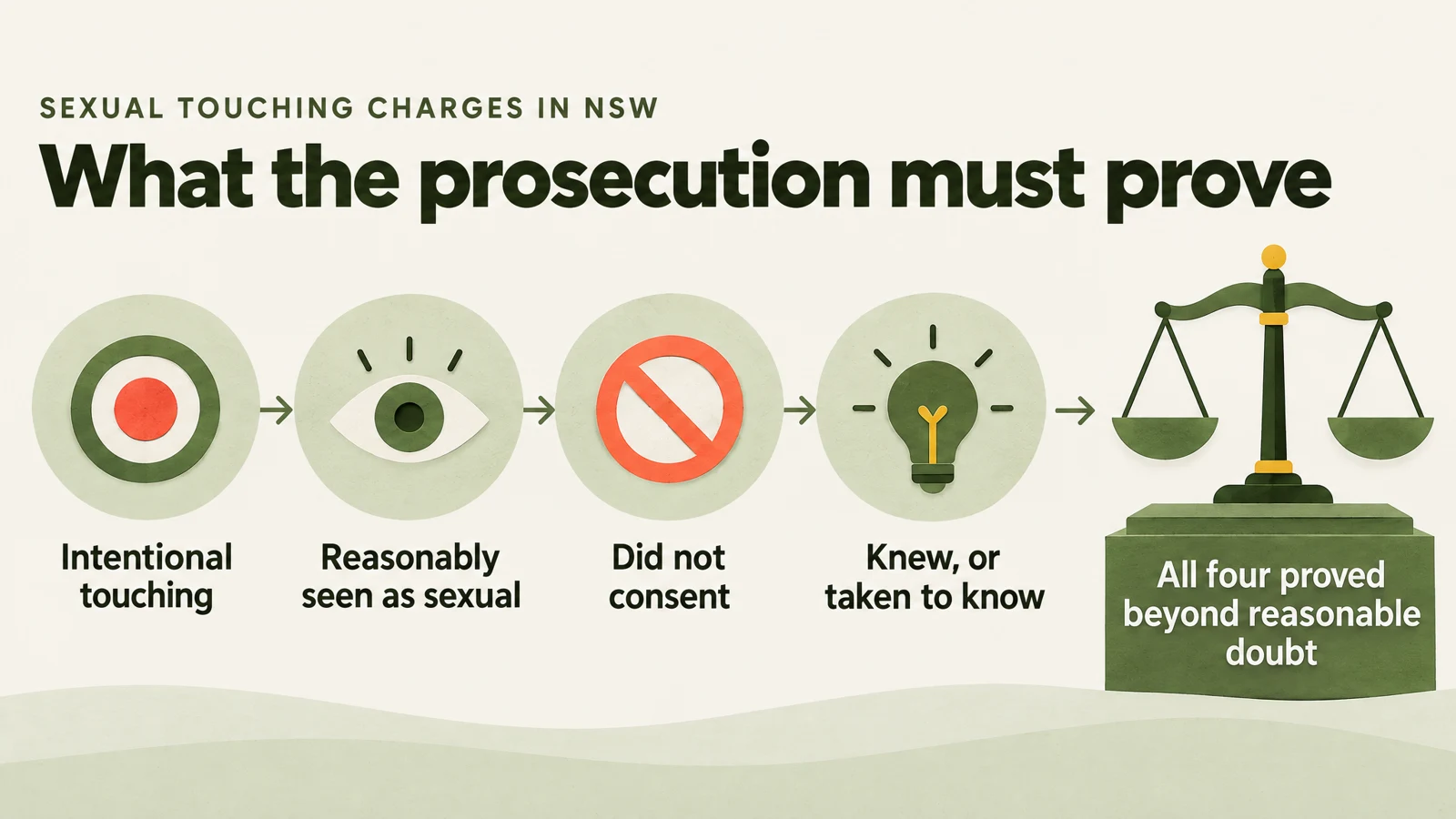
Consent and knowledge are usually the heart of the case. Under NSW’s affirmative consent laws, a person consents only if they freely and voluntarily agree at the time. A person who does not say or do anything to communicate consent does not consent, and a lack of resistance is not, on its own, consent.
You are taken to know there was no consent if you actually knew, were reckless about it, or held a belief in consent that was not reasonable in the circumstances. A belief is generally not reasonable if you did not say or do anything to find out whether the person consented.
Self-induced intoxication is ignored when the court decides what you knew. These rules apply to conduct on or after 1 June 2022; earlier conduct is judged under the previous consent law.
What are the penalties for sexual touching in NSW?
The maximum penalty for sexual touching is 5 years’ imprisonment, but in the Local Court the maximum for a single offence is 2 years. Maximum penalties are reserved for the most serious cases.
| Offence | Section | Maximum penalty | Usual court | Local Court maximum |
|---|---|---|---|---|
| Sexual touching | s 61KC | 5 years | Local Court unless the prosecution elects | 2 years |
| Aggravated sexual touching | s 61KD | 7 years | Local Court unless the prosecution or you elect | 2 years |
| Sexual act | s 61KE | 18 months | Local Court unless the prosecution elects | 18 months |
| Aggravated sexual act | s 61KF | 3 years | Local Court unless the prosecution elects | 2 years |
For aggravated sexual touching dealt with in the District Court, a standard non-parole period of 5 years applies if you were 18 or over at the time. That is a legislative guidepost for an offence in the middle of the range of seriousness, not a mandatory minimum, and it does not apply in the Local Court.
Sentencing in practice
No law requires a prison sentence for these offences. The Judicial Commission’s Sentencing Bench Book says the sentencing principles for indecent assault, the offence sexual touching replaced, may be relevant. Under those principles, courts place each case on a scale of seriousness, looking at the nature and degree of the contact, any force, and any humiliation involved.
Contact with the skin, or touching of the genital area, is treated as more serious. The Court of Criminal Appeal has also said it is too strict to treat custody as necessary in every indecent assault case.
Depending on the offence, sentence and circumstances, possible outcomes vary. These may include a dismissal or conditional release without conviction to a community-based order, an intensive correction order where the statutory requirements are met, or imprisonment.
We do not quote outcome averages, because results turn on the facts and your circumstances.
Which court will hear my case?
Sexual touching charges are dealt with in the Local Court unless an election moves them to the District Court. For basic sexual touching, sexual act and aggravated sexual act, only the prosecution can elect to move the case to the District Court. For aggravated sexual touching, you can also elect.
These are treated as sexual offence proceedings, so the complainant has protections under the Criminal Procedure Act 1986 (NSW). Their evidence is usually given in a closed court, and they can give it by CCTV or with other support arrangements. If you are unrepresented, you cannot cross-examine them yourself.
Evidence about their sexual reputation or experience is generally inadmissible. Publishing anything that identifies them is generally a criminal offence.
What else can follow a sexual touching charge?
A sexual touching charge can bring consequences beyond the sentence, including an apprehended violence order and a bar on working with children. Registration as a sex offender depends on the complainant’s age.
An apprehended violence order (AVO). A charge for one of these prescribed sexual offences generally triggers the interim-AVO provisions. The court must make an interim AVO protecting the complainant unless it is satisfied that an order is not required. After a guilty plea or finding of guilt, the court must generally make a final AVO, again subject to the statutory exception (ss 39 and 40 Crimes (Domestic and Personal Violence) Act 2007 (NSW)).
Breaching an AVO is a separate offence. Our AVO fact sheet explains how these orders work.
Your Working with Children Check. Under the Child Protection (Working with Children) Act 2012 (NSW). If proceedings are commenced for a listed sexual offence allegedly committed when you were an adult, the Working with Children Check legislation can disqualify you from holding a clearance while the proceedings are pending. The precise effect depends on the offence, the complainant’s age and the statutory criteria.
A finding of guilt, even without a conviction being recorded, also disqualifies. A disqualification reassessment can be sought in some cases.
The sex offender register. Under the Child Protection (Offenders Registration) Act 2000 (NSW), sexual touching and sexual act offences are registrable only where the complainant was under 18. Where the complainant was an adult, registration is not automatic.
A court can still order registration, on an application, if it is satisfied you pose a risk to the safety of children. That is a separate step, and it is not available if the case ends in a section 10 dismissal or conditional release without conviction.
A criminal record. A conviction appears on your record and can affect employment, professional registration and travel.
Your rights and what you can do now
You have the right to stay silent and the right to legal advice, and using both is the most protective step you can take. Your rights:
- The right to silence. You generally have a right to silence, subject to limited exceptions. Before answering questions or taking part in an interview, obtain legal advice about what you are required to provide and what may be in your interests to say. Our guide to police questioning in NSW explains how this works.
- The right to a lawyer. You can ask to speak to a lawyer before deciding whether to say anything.
- The presumption of innocence. The prosecution must prove the charge. You do not have to prove your account.
Practical steps:
- Do not contact the complainant, directly or through friends, family or social media. It can breach bail or AVO conditions and lead to further charges.
- Keep every message, photo and call log. Do not delete anything; your lawyer needs the full picture.
- Write down your recollection now: the date, the place, who was there, and what was said and done before, during and after.
- List possible witnesses and records, such as venue CCTV or rideshare and booking records. CCTV can be overwritten quickly.
- Follow your bail conditions and any AVO exactly, and stay off social media about the allegation.
How a lawyer could help your sexual touching case
A criminal defence lawyer tests whether each element can actually be proved, and looks for the avenues that fit your facts. Depending on the circumstances, those may include:
- Whether the touching was intentional and “sexual”. The offence requires deliberate touching that a reasonable person would consider sexual. Accidental contact, or contact in a crowd, may not meet that test, and in a crowded place identification itself may be in issue.
- Consent and knowledge. Messages, the conduct of both people, and what was said before and after can bear directly on whether the prosecution can prove there was no consent and that you knew it.
- The right law for the right date. For older allegations, a lawyer checks that you are charged under the law that applied at the time, including the old consent rules for conduct before 1 June 2022.
- Negotiation. Where the evidence is weak, a lawyer may make written representations seeking to have a charge withdrawn, or an aggravated charge reduced to the basic offence.
- Court and sentence. For aggravated sexual touching, a lawyer advises whether to keep the case in the Local Court. If you plead guilty, they gather references and treatment or counselling evidence and argue for the least restrictive outcome available, including a community-based order.
- Opposing a registration order where a court is asked to place you on the register for an adult-complainant offence.
No lawyer can promise a particular result. You can read more about how we defend these matters on our sexual assault lawyers page. For the more serious charge of sexual intercourse without consent, see our sexual assault charges fact sheet.
Frequently asked questions
Is sexual touching the same as indecent assault?
Not exactly, but it is the offence that replaced it. Sexual touching was one of the offences introduced to replace indecent assault and related act-of-indecency offences on 1 December 2018 and carries the same 5-year maximum. Conduct alleged to have happened before that date is generally still charged as indecent assault under the old section.
Can touching over clothes be sexual touching?
Yes. The definition expressly includes touching through anything, including clothing. The question is whether a reasonable person would consider the touching sexual in all the circumstances.
Will I go on the sex offender register for sexual touching?
Not automatically, if the complainant was an adult. Sexual touching is a registrable offence only where the complainant was under 18. For an adult complainant, registration generally follows only if a court makes a separate order after finding you pose a risk to children.
Will I go to jail for sexual touching?
Not necessarily. No law makes full-time custody mandatory for this offence, and the Local Court cannot impose more than 2 years for a single offence. The outcome depends on the seriousness of the conduct, your history and your circumstances, so no result can be assured.
Can I get a section 10 for sexual touching?
It is legally available, but it depends heavily on the seriousness of the conduct. A court can dismiss the charge or impose a conditional release order without conviction, depending on your character, the circumstances and the nature of the offence. Even then, a finding of guilt still affects a Working with Children Check.
I had been drinking. Does that help my case?
No. Self-induced intoxication must be ignored when deciding whether you knew the person was not consenting, and it is not a mitigating factor on sentence.
The allegation is from years ago. Can I still be charged?
Yes. There is no general time limit on prosecuting these offences. If the conduct is alleged to have happened before 1 December 2018, the old indecent assault or act of indecency sections apply.
How O’Brien Criminal & Civil Solicitors can help
A sexual touching charge puts your reputation, your work and your freedom at risk. O’Brien Criminal & Civil Solicitors is a specialist criminal defence firm led by an Accredited Specialist in Criminal Law (fewer than 6% of NSW lawyers hold specialist accreditation). The firm has practised in criminal defence in NSW for more than 20 years.
We act from your first contact with police and test every element of the prosecution case. You get clear, confidential advice about your options, including the effect on your Working with Children Check and any registration risk. We strive to achieve the best possible outcome in every matter.
Request initial advice (no-obligation) via the form below or call us on (02) 9261 4281.
This content is for general information purposes only and does not constitute legal advice. You should seek independent legal advice relevant to your specific circumstances.