
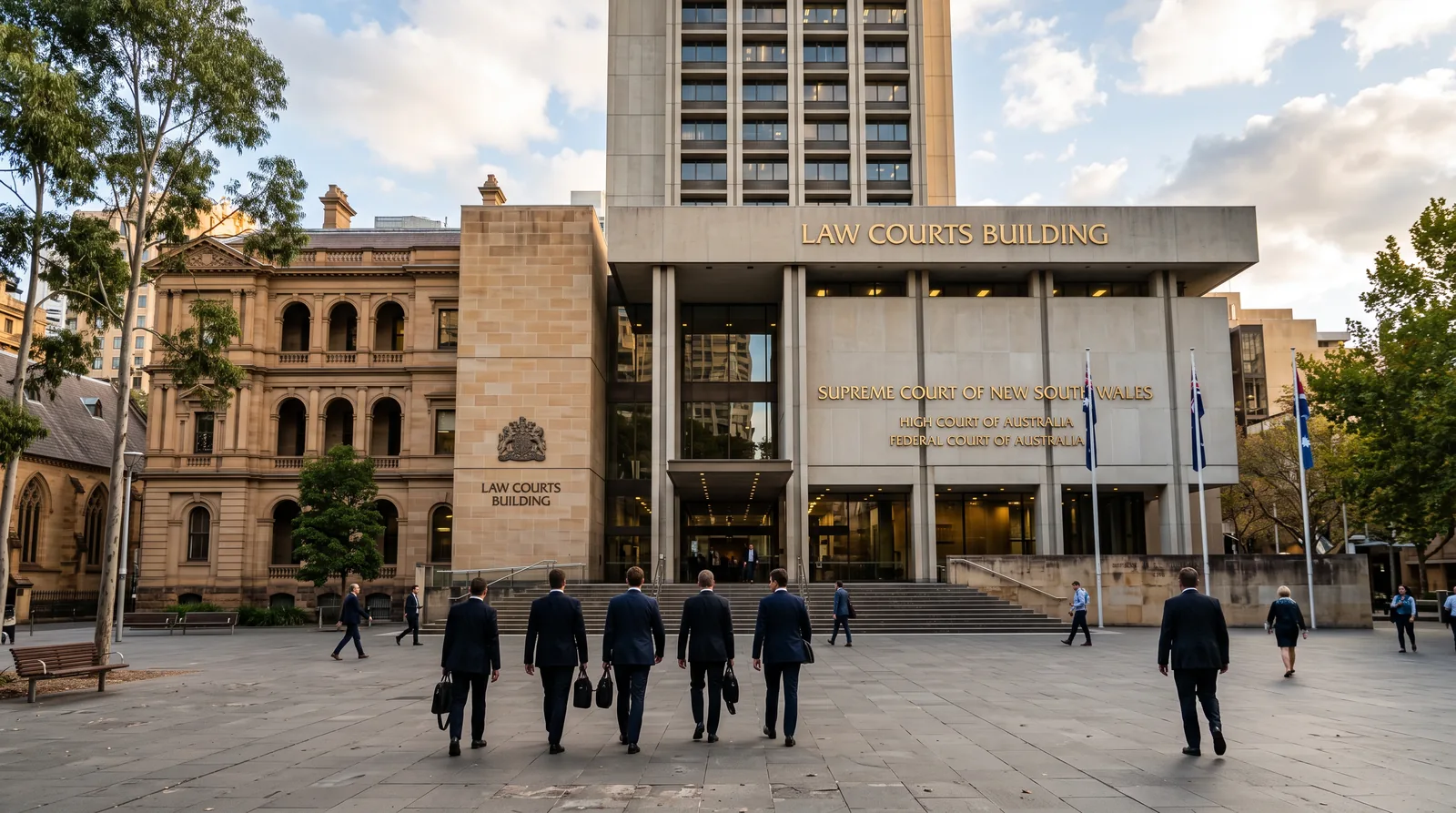
If you or someone you love has been charged with a criminal offence in NSW, one of the first questions is usually: which court will this be heard in? This is important as the answer changes almost everything else, including how long the process takes, whether a jury decides your fate, what the maximum penalty could be, and what your lawyer needs to prepare for.
NSW criminal matters move through three courts: the Local Court, the District Court, and the Supreme Court.
Many charges are finalised in the Local Court. A smaller number move up to the District or Supreme Court, either because the law requires it or because you or the prosecution choose it. Each has a different process, a different decision-maker, and different stakes.
This guide explains, in plain English, how NSW decides which court hears which offence, what happens as a case moves from the Local Court upward, and how appeals work if you want to challenge a result. It draws on the Criminal Procedure Act 1986 (NSW) and the Crimes (Appeal and Review) Act 2001 (NSW).
At a glance
- Local Court: hears summary offences and the Table offences that stay there, decided by a Local Court Judge alone. For Table offences, the sentencing power is generally 2 years per offence, and the Local Court cannot impose an aggregate sentence of more than 5 years.
- District Court: hears indictable offences too serious for the Local Court (and Table offences someone has elected to move up), usually tried by a judge and jury. The only indictable offences it cannot hear are those prescribed by regulation: murder and treason.
- Supreme Court: has jurisdiction over all indictable offences and is the only court that can hear murder and treason. Tried by a judge and jury, unless a judge-alone order is made.
- Moving from Local Court to a higher court: happens through charge certification and case conferencing, not the old “committal hearing” (that process was replaced in 2018).
- The one thing to do now: get a criminal lawyer involved before your first court date. Which court your matter belongs in, and whether to contest jurisdiction, are decisions best made early.
Which court hears my charge: Local, District, or Supreme?
It depends on how the law classifies the offence: summary, indictable, or a Table offence that can go either way.
- Summary offences, the least serious category (for example minor traffic matters and low-range offensive conduct), are always finalised in the Local Court, with no jury.
- Strictly indictable offences, the most serious charges (for example murder, manslaughter, the most serious sexual offences and commercial-scale drug supply), are not in the Tables. They are dealt with in the District Court or Supreme Court, usually before a judge and jury.
- Table offences sit in between. These are indictable offences (depending on the details, some assault, break and enter, drug and property offences) that are dealt with in the Local Court unless someone elects otherwise (Criminal Procedure Act 1986 (NSW) s 260). Table 1 offences can be moved to the District Court by either the prosecution or the accused. Table 2 offences can only be moved by the prosecution: the accused has no right to elect. Common assault under s 61 of the Crimes Act 1900 (NSW) is an example of a Table 2 offence.
For a Table offence dealt with in the Local Court, the Criminal Procedure Act 1986 (NSW) (ss 267 and 268) sets the maximum prison term at 2 years for a single offence, or the offence’s own maximum if that is shorter.
Separately, the Crimes (Sentencing Procedure) Act 1999 (NSW) limits the Local Court to an aggregate sentence of no more than 5 years (s 53B). This stops it stacking a new sentence on an existing one so that the total runs more than 5 years from when the first began (s 58).
Both limits sit well below what many Table offences carry on paper. So why would someone elect for the District Court? If a genuinely contested case could attract a sentence beyond the Local Court’s power, staying in the Local Court effectively puts a ceiling on the outcome, whatever the maximum penalty says.
This guide focuses on the structural picture: which court, and how a matter gets there. For a full breakdown of summary vs indictable offences, including table offences and how a charge can be upgraded or downgraded, see our dedicated fact sheet on summary and indictable offences.
What actually happens in the Local Court?
For most people charged with a criminal offence in NSW, the Local Court is the only court they will ever see. It handles the overwhelming majority of criminal charges in the state.
A Local Court Judge, a single judicial officer with no jury, decides both the facts and the law. Until 28 March 2026 these officers were called magistrates, and many people (and older guides) still use that word. Local Court proceedings are comparatively fast: many summary and Table matters are resolved within a few court appearances, particularly on a guilty plea.
If you plead guilty, the Judge sentences you (within the Local Court’s power) at, or shortly after, that hearing. If you plead not guilty, the matter proceeds to a defended hearing, the Local Court’s version of a trial, but without a jury; the Judge hears the evidence and delivers the verdict.
What actually happens in the District Court?
The District Court deals with indictable offences that are too serious for the Local Court, or Table offences someone has elected to move up.
Under s 46 of the Criminal Procedure Act 1986 (NSW), it can hear every indictable offence except those prescribed by regulation. The regulation excludes the offences in ss 12 and 19A of the Crimes Act 1900 (NSW), which are treason and murder, so those go to the Supreme Court.
Trials here are ordinarily heard by a judge and a jury of 12 (Jury Act 1977 (NSW) s 19). Either side can apply for a judge-alone trial under s 132 of the Criminal Procedure Act. The court must order one if both sides agree, and cannot order one unless the accused agrees. If the prosecution does not agree, the court may still order one if it considers that in the interests of justice, though it can refuse where the trial turns on a question that needs community standards applied, such as reasonableness or negligence. The jury (where there is one) decides guilt or innocence as the “judge of the facts”; the judge rules on the law and, on a guilty verdict, decides the sentence.
As the stakes and the process are more serious, District Court matters usually involve a legal team of a solicitor and a barrister. A solicitor manages the case, and the barrister appears in court and runs the trial.
What actually happens in the Supreme Court?
The Supreme Court has jurisdiction over all indictable offences, and it is the only court that can hear murder and treason. Other very serious charges, such as manslaughter, are within the jurisdiction of both the District and Supreme Courts, so which court your matter is listed in is something your lawyer can confirm.
Supreme Court trials are also heard by a judge and a jury of 12. They follow basically the same process as a District Court trial (arraignment, Crown case, defence case, addresses, summing up, and verdict). However, they are at a level reserved for cases where the consequences, and the legal complexity, are usually greatest.
A Supreme Court trial is not simply the District Court but more serious. Cases here more often involve extended pre-trial argument, longer trials, and a legal team that typically includes senior counsel for the most serious matters.
How does a case move from the Local Court to a higher court?
This is the step that confuses most people, partly because the old terminology is still in wide use. The old “committal hearing” was replaced in NSW in 2018. A strictly indictable charge, or an elected Table offence, no longer goes through a hearing where a Local Court Judge decides whether the evidence is strong enough to send it up for trial.
It now moves through two main stages under Chapter 3, Part 2 of the Criminal Procedure Act 1986 (NSW):
- Charge certification. The prosecution files a charge certificate by a date the Local Court Judge sets after the brief of evidence has been served, which can be no later than 6 months after the first return date for the court attendance notice (s 67). The certificate sets out the charges it intends to proceed with and certifies that the available evidence is capable of establishing each element (s 66). The Judge can set a later date with your consent or in the interests of justice. If the certificate is not filed in time, the Judge must either discharge you or adjourn the matter (s 68).
- Case conferencing. After the charge certificate is filed, your lawyer and the prosecutor hold a case conference. Its main aim is to work out whether there are any offences you are willing to plead guilty to (s 70). The outcome is recorded in a case conference certificate.
The Local Court Judge then commits the accused for trial or sentence (s 95), after the case conference certificate is filed, or after the charge certificate if no case conference is required. The Judge must commit for trial unless a guilty plea is accepted (s 96), and commits for sentence to the District or Supreme Court if a plea is accepted (s 97). That final step is still called committal, which is the source of the confusion. A Judge can still direct a witness to attend and give evidence at the committal proceedings, but only on application, after the charge certificate is filed, and only with the other side’s consent or for substantial reasons in the interests of justice (s 82).
In practice, this means:
- You will still deal with the Local Court first, even if your charge will ultimately be heard in the District or Supreme Court.
- The charge certificate deadline is a genuine safeguard. If the prosecution misses it, the Local Court Judge must discharge you or adjourn the matter.
- The case conference is a real opportunity to test the strength of the prosecution’s evidence and, where appropriate, negotiate the charges, before your matter reaches a higher court.
How does an appeal work if I disagree with the outcome?
Every level of the NSW court system has an appeal pathway above it, but the process and the deadlines differ depending on where your case started.
| From | To | What’s reviewed | Time limit |
|---|---|---|---|
| Local Court | District Court | Conviction, sentence, or both (a rehearing on the evidence given in the Local Court; fresh evidence only with the District Court’s leave (or freely on a sentence appeal) | 28 days after sentence as of right (Crimes (Appeal and Review) Act 2001 s 11); late appeals only with the District Court’s leave, applied for within 3 months (s 13) |
| District or Supreme Court (trial) | Court of Criminal Appeal (CCA) | A conviction on a question of law alone as of right; other conviction grounds and any sentence appeal only with leave (or a trial judge’s certificate for conviction grounds) (Criminal Appeal Act 1912 s 5). The CCA allows a conviction appeal if the verdict is unreasonable, a question of law was wrongly decided, or there was any miscarriage of justice (s 6) | Notice of intention to appeal within 28 days; the court may extend this at any time (s 10) |
| Court of Criminal Appeal | High Court of Australia | Only with special leave, which the High Court decides having regard to matters such as questions of law of public importance (Judiciary Act 1903 (Cth) s 35A) | Application generally within 28 days of the judgment; late applications need an order dispensing with the time limit (High Court Rules 2004 r 41.02) |
An appeal from the Local Court to the District Court is a rehearing on the evidence given in the Local Court (ss 17 and 18). Fresh evidence may be given on a sentence appeal, and on a conviction appeal only with the District Court’s leave, if it is in the interests of justice. From the District or Supreme Court to the Court of Criminal Appeal, the process is different: it is an appeal under the Criminal Appeal Act 1912, not a new trial.
One trap worth knowing: if you were convicted in your absence or following a guilty plea, there is no appeal as of right against the conviction. You need the District Court’s leave (s 12), applied for within 28 days after sentence (s 12(3)), and a sentence appeal remains available as of right. Different rules apply, so get advice quickly.
This guide covers the pathway between courts at a structural level. For a full breakdown of appeal grounds, costs, and what a severity or conviction appeal actually involves, see our dedicated fact sheet on criminal appeals in NSW.
Your Rights & What You Can Do Now
Wherever your matter is heard, you have rights that don’t change with the court:
- You have the right to legal representation at every stage, from your first Local Court appearance through to any appeal.
- You have the right to know the exact charges against you, including the charge certificate, once filed, which sets out precisely what the prosecution intends to prove.
- You have the right to test the prosecution’s evidence. The case conference stage exists partly so your lawyer can scrutinise what’s actually being alleged before your matter goes further.
- You are not required to prove your innocence. The prosecution carries the burden of proving every element of the charge, in every court, to the criminal standard of beyond reasonable doubt.
Practical steps that strengthen your position:
- Get advice before your first Local Court date, not after. Early advice can affect whether a Table offence should be elected up or kept in the Local Court, a decision that’s far harder to unwind later.
- Keep every document: the court attendance notice, any charge certificate, and correspondence from police or the DPP. Your lawyer will need all of it.
- Don’t rely on informal advice about “which court this will end up in.” The classification of an offence, and whether it’s Table 1 or Table 2, has real consequences for sentencing exposure and strategy, so get it confirmed properly.
- If a deadline has passed, particularly an appeal time limit, get advice immediately. The rules for late appeals differ from court to court, and a late appeal from the Local Court must be applied for within 3 months.
How a Lawyer Could Help Your Case
Which court your matter is heard in, and how it gets there, is often shaped by decisions made early, and a solicitor’s role starts well before any trial date.
- Assessing whether to elect a Table offence up or keep it in the Local Court, weighing the Local Court’s sentencing cap against the strength of the prosecution case and the realistic range of outcomes at trial.
- Scrutinising the charge certificate for whether the alleged evidence genuinely supports every element of each charge, and pursuing withdrawal or downgrading of charges that don’t hold up.
- Using the case conference to test the prosecution’s position, explore whether charges can be negotiated or reduced, and advise on any plea offer, including the discount available for an early guilty plea.
- Preparing bail applications at whichever court currently has carriage of the matter, since bail conditions can change as a case moves between courts.
- Advising on judge-alone trial applications in the District Court, where that may suit the case.
- Running an appeal, where there are proper grounds, from a Local Court rehearing through to the Court of Criminal Appeal, including advising honestly on the prospects and the deadlines involved.
None of this guarantees a particular outcome; every case turns on its own facts. But decisions about jurisdiction and process, made with proper advice early, genuinely shape what options remain later.
Frequently Asked Questions
Do I get a say in which court hears my case?
Sometimes. If your charge is a Table 1 offence, you can elect to have it dealt with on indictment, in the District Court, instead of the Local Court, for example because the Local Court’s 2-year sentencing limit doesn’t reflect the real risk you’re facing, or because you want a jury. If it’s a Table 2 offence, only the prosecution can elect; you cannot. Strictly indictable and purely summary offences aren’t subject to election at all: the law fixes the court.
Is the Local Court “less serious” than the District or Supreme Court?
Not necessarily. The Local Court hears the majority of NSW criminal matters, including some genuinely serious Table offences, and a conviction there still carries a criminal record and real penalties, including full-time imprisonment, generally up to 2 years per offence for a Table offence. What differs is the process (no jury, capped sentencing power) and the range of matters heard, not the seriousness of every individual case.
What happened to committal hearings? Do they still exist in NSW?
Not in the old form. The Local Court Judge’s decision about whether the evidence is strong enough to go to trial was removed in 2018. It was replaced with charge certification and case conferencing under the Criminal Procedure Act 1986 (NSW). The final step, the Judge formally sending a matter to a higher court, is still called committal for trial or sentence, but it follows those two steps. In limited cases a witness can still be directed to attend.
Are Local Court magistrates now called judges?
Yes. From 28 March 2026, magistrates in the NSW Local Court became Judges of the Local Court. The title changed; the Local Court’s powers did not, and it remains a court without a jury. Older guides, and many people, still say “magistrate”.
How long does it take for a case to move from the Local Court to the District or Supreme Court?
It varies, but the law sets an outer limit for the first step. The charge certificate is to be filed by a date the Local Court Judge sets, no later than 6 months after the first return date, unless the Judge allows longer (s 67). After that, a case conference is held before the matter is committed. Complex matters, or those involving multiple co-accused, can take longer.
Can my case move from the District Court to the Supreme Court, or vice versa?
Rarely, and only in limited circumstances. Jurisdiction is generally fixed by the offence: murder and treason must be heard in the Supreme Court, and the District Court can hear any other indictable offence. Charges can occasionally change (for example, a murder charge reduced to manslaughter), which can change which court is appropriate, but this isn’t something either side elects freely.
Do I need a barrister as well as a solicitor?
Often, for District and Supreme Court matters. Local Court matters are commonly run solicitor-only. Once a matter reaches trial in the District or Supreme Court, it’s standard for a solicitor to instruct a barrister to appear and run the trial, and for the most serious Supreme Court matters, senior counsel is common.
How O’Brien Criminal & Civil Solicitors Can Help
Knowing which court your matter belongs in, and whether that’s actually the best place for it, is one of the earliest and most consequential decisions in a criminal case. O’Brien Criminal & Civil Solicitors is led by an Accredited Specialist in Criminal Law, and our team has acted in matters across the Local, District, and Supreme Courts, and on appeal to the Court of Criminal Appeal, for over 20 years.
We get involved from the first police contact where possible, because decisions about jurisdiction, election, and how to approach the case conference are often made long before a trial date is set, and made well, they can shape everything that follows.
Request initial advice (no-obligation) via the form below or call us on (02) 9261 4281.
This content is for general information purposes only and does not constitute legal advice. You should seek independent legal advice relevant to your specific circumstances.