

Bail conditions are often set soon after arrest and may no longer fit your work, home or family arrangements. A bail variation is the process for asking a court or registrar to change them.
This guide covers who can apply, where the application goes, how much notice is needed, what the court weighs, and what happens if a condition is breached in the meantime.
Bail variation at a glance (NSW)
- The law: an “interested person” can apply to change bail conditions under section 51 of the Bail Act 2013 (NSW).
- Who decides: a magistrate or judge, or a court registrar for reporting, residence, association and curfew conditions set by a court, if nobody objects.
- Notice: the other side must get reasonable notice. The Act sets no fixed number of days.
- Breach: breaching a condition is not a crime in itself, but police can arrest you and bail can be revoked. Failing to appear at court is a separate offence.
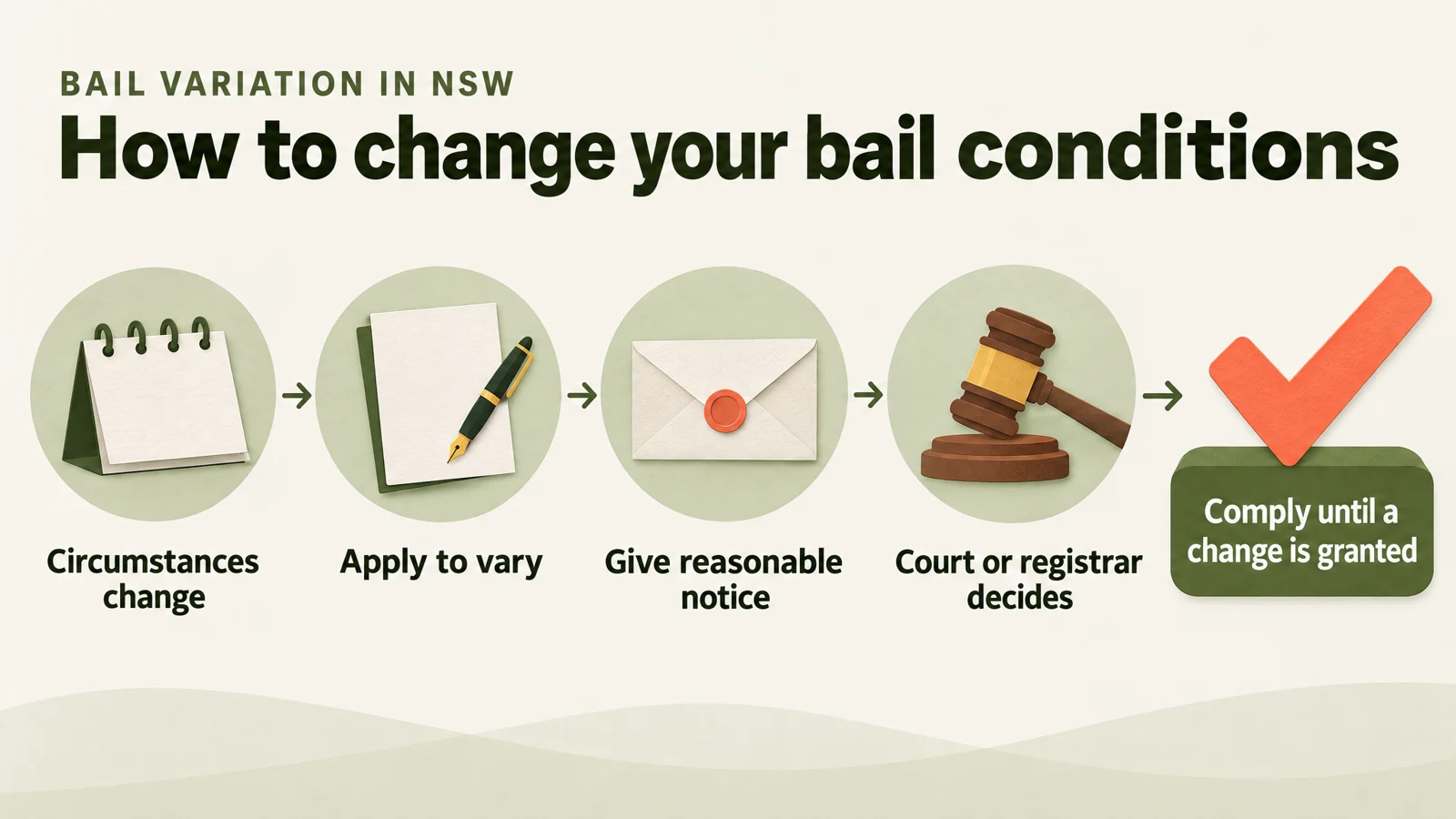
- Do now: keep complying with every current condition until a variation is actually granted.
What is a bail variation?
A bail variation changes your bail conditions. It can remove, replace, add or tighten a condition. The prosecution can also apply for stricter conditions or revocation.
Among other things, conditions can require you to do or not do something, such as report to police or stay away from a person. They can also require you to put up money as security, provide character acknowledgments, or comply with police directions that check your compliance (enforcement conditions).
For how bail is granted, including the show cause and unacceptable risk tests, see our guide on bail applications in NSW.
Who can apply to vary bail conditions?
The person on bail, a prosecutor, an Attorney General, and in some cases, a domestic violence complainant or a person protected by an AVO. All of them are called an interested person.
| Interested person | When they can apply | Section |
|---|---|---|
| The accused (the person granted bail) | Any time while on bail | s 51(3)(a) |
| The prosecutor (police or the DPP) | Any time | s 51(3)(b) |
| The complainant | Only where the charge is a domestic violence offence | s 51(3)(c) |
| The protected person | Only where bail was granted on an application for an AVO | s 51(3)(d) |
| The Attorney General | Any time | s 51(3)(e) |
If a complainant or protected person applies, the court cannot vary bail until the prosecutor has had a reasonable opportunity to be heard (s 51(8)).
Also, a court cannot revoke bail on a variation application, including your own, unless the prosecutor asks it to. That cuts both ways: if you apply, the prosecutor can ask for revocation too.
Where do you apply: the court, the Local Court or a registrar?
Usually to the court that set your bail, the court your case is now in, or the Local Court. Some routine changes to court-set bail can be made by a registrar, without a magistrate, but only if the other side does not object.
A court can always hear a variation of its own bail decision (s 63). Beyond that, the rules depend on which court set bail and where your case now sits.
| Decision-maker | What it can vary | Key limits |
|---|---|---|
| Registrar of the Local Court or Children’s Court | Reporting, residence, association and curfew conditions set by a court, not police bail (s 64(5)) | Can change, but not remove, residence, association and curfew conditions. Only if the other side was notified and has not objected (s 52). Not if the court directed that a registrar must not vary it (s 57(2)), and never enforcement conditions (s 58) |
| Local Court (magistrate) | Any condition, including one set by police (s 64(3)) or a higher court (s 64(4)) | Cannot vary a higher court’s condition marked not to be varied by the Local Court, unless you and the prosecutor both agree (s 57). Once your case is in a higher court and you have appeared there, only with both sides’ consent (s 68) |
| District Court | Conditions in matters before it, and its own decisions | May decline an application the Local Court or a registrar could deal with (s 73(2)) |
| Supreme Court | Supreme Court: Conditions set by the District Court, the Local Court or police (s 66) | May decline an application the Local Court or a registrar could deal with (s 73(2)) |
If the Supreme Court or the Court of Criminal Appeal sets your bail, a lower court’s power is limited. It can hear your application only if your case is before it, you appear there, and there are special facts or special circumstances (s 69).
Registrars have a further limit. Once your Local Court case has finished, a registrar can only change reporting days, times or the police station. The same limit applies to any condition the Supreme Court imposed (s 52(5) and (6)).
If bail was refused and you are in custody, you need a release application, not a variation. Our guide to Supreme Court bail in NSW covers that.
How do you apply, and how much notice is needed?
Apply in the approved written form, setting out the change you want and why. If you are already before the court, you may apply orally. The other side must receive reasonable notice; the Act does not set a fixed number of days.
The court or registrar then notifies the applicant, the accused and the prosecutor of the hearing. If you are notified and do not attend, the application can be decided without you (Bail Regulation cl 21(3)). A court cannot hear an application by anyone other than the prosecutor unless the prosecutor has had reasonable notice, and the accused has the same protection (s 51(6) and (7)).
In practice:
- Use your first court date. If you apply on a first appearance, the court must hear it even if the prosecutor has had no notice, though it may adjourn (s 72).
- Ask police first. A registrar can only vary a condition if the prosecutor does not object, so consent can save a contested hearing.
- Expect some wait. Bail applications must be dealt with as soon as reasonably practicable (s 71), but listing times vary by court.
- Get it in writing. You must be given written notice of any varied condition (s 35).
What does the court consider when deciding a variation?
The same framework as the original bail decision. The court looks at the bail concerns in your case and asks whether each condition, as varied, is a fair and necessary response to them.
Section 15 applies the bail decision rules to a variation in the same way. The bail concerns are that you might fail to appear, commit a serious offence, endanger someone’s safety, or interfere with witnesses or evidence (s 17). For some serious charges, known as show cause offences, the show cause requirement may also be relevant.
Under section 20A, a condition can only be imposed if it is:
- reasonably necessary to address a bail concern;
- reasonable and proportionate to the offence;
- appropriate to that concern;
- no more onerous than necessary;
- reasonably practicable for you to comply with; and
- backed by reasonable grounds to believe you will comply with it.
A variation argument is usually built on these tests. A curfew that blocks night shifts, or reporting three times a week two hours from home, may be argued to be more onerous than necessary or not reasonably practicable.
What bail conditions can be varied?
Any condition can be the subject of an application, but some are routinely changed and others are much harder to shift.
| Condition | Typical reason to vary | What usually helps |
|---|---|---|
| Curfew | Shift work, study, caring duties | An employer or institution letter with exact hours |
| Reporting | Moving house, work hours, travel time | A proposed new station or days, and your reporting record |
| Residence | A lease ending, moving for work | The new address and who lives there |
| Non-contact or place restriction | Shared children, a shared workplace | A narrow, specific change rather than removal |
| Travel or passport | A funeral, work trip or family event overseas | Dates, itinerary and return ticket. A registrar cannot vary a passport condition, so that needs a court |
| Electronic monitoring | Imposed for a serious domestic violence offence | Reasons in the interests of justice (s 28B) |
In domestic violence matters, courts take conditions protecting a complainant very seriously, and a complainant wanting contact does not mean a condition will be lifted. If there is also an apprehended violence order, that order is separate, and changing bail does not change it. See our guide to apprehended violence orders in NSW.
Still in custody because you cannot meet a condition, such as finding a surety? A court can review the conditions without a formal application (s 55), but cannot refuse or revoke bail on that review.
What happens if you breach your bail conditions?
Breaching a bail condition is not, by itself, a criminal offence. But it puts your bail at risk: police can arrest you, and a court can tighten your conditions or revoke bail.
Under section 77, if police reasonably believe you have breached, or are about to breach, a condition, they can:
- take no action, or give you a warning;
- issue a notice requiring you to attend court;
- issue a court attendance notice, if the conduct is itself an offence (such as contacting someone protected by an AVO);
- arrest you without a warrant and take you before a court; or
- apply for a warrant for your arrest.
Police must consider how serious the breach was, whether you had a reasonable excuse, your circumstances, and whether something short of arrest is appropriate. A court can then release you on your original bail or vary the decision, which includes revoking bail (s 78).
Your history of compliance also counts in later bail decisions (s 18). If you are before the court because of a breach, any earlier warnings about non-compliance are considered too (s 18(1)(f1)).
Is failing to appear at court an offence?
Yes. Failing to appear at court as your bail requires, without a reasonable excuse, is an offence in its own right under section 79.
You must prove the reasonable excuse. The maximum penalty is the maximum for the offence you were on bail for, but capped at 3 years’ imprisonment and 30 penalty units (currently $3,300). If something stops you getting to court, contact your lawyer or the registry before the listing, not after.
Your rights and what you can do now
You have the right to ask for your conditions to be changed, and to be told in writing of any change. The most important thing is to keep complying while you ask.
Your rights:
- To apply at any time, as the person on bail.
- To reasonable notice if anyone else applies to change your bail, unless the court dispenses with notice, for example because you cannot be contacted (Bail Regulation cl 21(4)).
- To protection from revocation: bail cannot be revoked on any variation application, yours or anyone else’s, unless the prosecutor asks for it.
- To written notice of any varied condition.
Practical steps:
- Comply with every current condition until a variation is granted.
- Write down exactly what you want changed, with dates, times and addresses.
- Gather evidence: employer letters, rosters, leases, medical certificates, itineraries.
- Keep a record of your compliance, such as the dates you reported.
- If a breach has already happened, get legal advice quickly, before you discuss it with police.
How a lawyer could help your bail variation
A lawyer can identify the right forum, frame the request around the legal tests and, where possible, seek police consent first. Depending on the circumstances, that may include:
- Choosing the decision-maker, which turns on who set bail, where the case is, and any direction against variation.
- Negotiating consent with the officer in charge or the DPP, which can turn a contested hearing into an agreed one.
- Building the s 20A argument with evidence that a condition is more onerous than necessary or not reasonably practicable.
- Proposing alternatives, such as a narrower curfew or a different reporting station.
- Opposing a prosecution or complainant application to tighten conditions or revoke bail.
- Acting after a breach, including arguing reasonable excuse and release on your original bail.
No lawyer can promise a condition will be changed. Good preparation puts the strongest version of your application forward the first time.
Frequently asked questions
Can I change my bail conditions without going to court?
Sometimes. If a court set your bail, a registrar can vary reporting, residence, association and curfew conditions without a magistrate, provided the other side has been notified and does not object. Police bail conditions, any other change, or an opposed one, need a magistrate or judge.
How long does a bail variation take?
It depends on the court and whether the application is opposed. The Act requires bail applications to be dealt with as soon as reasonably practicable but sets no fixed timeframe. An agreed variation before a registrar is usually quicker than a contested hearing.
Can police change my bail conditions?
Not once a court has made a bail decision. Police can set conditions when they grant bail at the station, but after a court has dealt with bail, only a court or registrar can vary it. Before your first court date, a more senior officer can review police bail conditions, but only if that will not delay you getting to court (s 47).
Police can also apply for a variation like any interested person.
Can I travel overseas while on bail in NSW?
Only if your conditions allow it. If your bail includes a passport surrender or a travel restriction, it will need to be varied before you travel. A registrar cannot vary a passport condition, so that needs a court.
Can I apply to vary bail more than once?
Yes. The Act’s limit on repeat applications (s 74) covers release and detention applications, not variations. But a court can refuse to hear a hopeless or vexatious application (s 73), so wait until something has genuinely changed.
Is it an offence to breach bail conditions in NSW?
No, not in itself. But police can arrest you, a court can revoke your bail, and conduct that is also an offence (such as breaching an AVO) can be charged separately. Failing to appear at court is an offence under s 79.
What happens if I miss my bail reporting day?
Police have a range of options, from no action to arrest. They must consider how serious the breach was and whether you had a reasonable excuse. If you know you will miss a reporting day, get advice about varying the condition beforehand.
How O’Brien Criminal & Civil Solicitors can help
A bail condition that does not fit your life can cost you a job or a home, and a breach can cost you your liberty. O’Brien Criminal & Civil Solicitors is a specialist criminal defence firm, led by an Accredited Specialist in Criminal Law (fewer than 6% of NSW lawyers hold any Law Society specialist accreditation), with more than 20 years in criminal defence across NSW courts.
We can tell you quickly which forum can hear your application, approach police about consent, and build your application around the tests the court applies. Learn more about our criminal defence services in Sydney.
Request initial advice (no-obligation) via the form below or call us on (02) 9261 4281.
This content is for general information purposes only and does not constitute legal advice. You should seek independent legal advice relevant to your specific circumstances.