Being told a notification has been made about you is a particular kind of fear. As your registration is not just a job, it is years of training, a professional identity, and likely the only way you know how to earn a living.
If you have also been charged with an offence, the court date is rarely what’s keeping you awake at night. It’s probably the regulator.
NSW does not handle notifications the way the rest of the country does, and that catches practitioners out. This guide covers who deals with your matter, when your registration can be restricted, realistic timeframes, your reporting duties, how a criminal charge and a notification interact, and your appeal rights.
AHPRA notifications in NSW at a glance
- The mechanism: a notification about a practitioner’s conduct, performance or health, under Part 8 of the National Law (NSW), grounds in s144.
- Who handles it here: your NSW Council and the Health Care Complaints Commission, not AHPRA, because NSW is a co-regulatory jurisdiction (s6 Adoption Act).
- Most serious outcome: cancellation of registration, which only NCAT can order (s149C).
- Key deadlines: 7 days to self-report a serious charge (s130); 28 days to appeal (s161).
- Do now: do not send a written explanation before it has been reviewed. Your response becomes evidence.
What is a complaint or notification, and who can make one in NSW?
In NSW, a concern about a registered practitioner’s conduct, professional performance or health is usually a complaint to the HCCC and your Council. Nationally, AHPRA calls similar concerns “notifications”. In NSW, almost anyone can make a complaint.
The grounds in s144 of the National Law (NSW) are a conviction or criminal finding, unsatisfactory professional conduct or professional misconduct, lack of competence, impairment, or not being a suitable person to hold registration. A complaint must be in writing, with particulars of the allegations, unless it is made by a Council or the Secretary (s144D).
Why NSW is different: AHPRA, the National Board, the Council and the HCCC
In NSW, the HCCC and your health professional Council manage complaints about conduct, performance and health. AHPRA and the National Board still handle registration and receive mandatory notifications and self-reports, which they pass to NSW.
This is set out in legislation. Section 6 of the Health Practitioner Regulation (Adoption of National Law) Act 2009 (NSW) provides that NSW does not participate in the National Law’s health, performance and conduct process in Divisions 3 to 12 of Part 8. This is because it has kept its own system from before the national scheme. Queensland has a similar arrangement; but no other state or territory does.
| Body | Role for a NSW practitioner |
|---|---|
| AHPRA and the National Boards | Maintain registration and the national register. Receive mandatory notifications and s130 self-reports, then pass complaint matters to the HCCC/Council in NSW |
| Your NSW Council (one of 15, such as the Medical Council of NSW) | Manages complaints, imposes conditions, refers practitioners for health and performance assessments, and can suspend registration on an interim basis (s150) |
| Health Care Complaints Commission | Assesses every complaint, investigates serious ones, and through its Director of Proceedings decides on prosecution |
| NCAT (Civil and Administrative Tribunal) | Hears prosecuted complaints and appeals. The only body that can cancel registration |
What happens first, and how long does it take?
The Council and the HCCC consult before anything is decided, then one takes carriage. You will be told, and asked to respond in writing. Assessment takes weeks; investigation takes months, often close to a year.
Section 145A requires them to consult “before any action is taken on a complaint”. Section 145B then lets the Council make inquiries, refer the matter to the HCCC, refer you for a health or performance assessment, direct you to counselling, or refer it on to a Committee or NCAT.
| Step | Timeframe |
|---|---|
| Board passes your s130 self-report to your Council (s139I) | 3 business days |
| HCCC assessment (HCC Act s22) | 60 days; met in 73.5% of cases in 2024/25, average 45 days |
| Notice of the complaint to you (s16) | Within 14 days after assessment |
| HCCC investigation | No statutory limit; averaged 267 days in 2024/25 |
| Your submissions, where the HCCC proposes certain action after an investigation (s40) | In writing within 28 days |
Timing figures come from the HCCC Annual Report 2024-25.
Your written response is very important: on the Councils’ own account of the process, where a Council is managing the complaint it assesses the issue and asks the practitioner to respond.
Can your registration be restricted before anything is proved?
Yes, and this is what surprises people most. A Council can impose conditions on your registration, or suspend it outright, before any finding is made.
Section 150 says a Council must act if satisfied it is appropriate “for the protection of the health or safety of any person or persons … or if satisfied the action is otherwise in the public interest”, and s150(4) confirms it can do so whether or not a complaint exists. This is protective rather than punitive, and not a finding that you did anything, but the effect on your working life is immediate.
| Immediate action in NSW, 2024/25 | Figure |
|---|---|
| Cases referred to Councils, including review inquiries | 435 |
| Recorded outcomes, excluding review hearings | 389 |
| Conditions imposed on practice | 231 |
| Registrations suspended | 50 |
| Registrations surrendered | 14 |
| No immediate action taken | 94 |
These outcome figures count initial actions only and exclude reviews of immediate action decisions, which is why they total 389 rather than 435.
The Council must give written notice of the action and its reasons (s150(6)). The Law gives no express right to be heard before a s150 order is made, but s150B contemplates you or your adviser being present when the Council considers the question. If you are given that opportunity, it is the moment to put your position.
Your own reporting obligations, and the trap of saying too much
You have two duties: to self-report certain events about yourself under s130, and in some circumstances to make a mandatory notification about another practitioner. These go to AHPRA/National Board, and in NSW they are then treated as a complaint to the HCCC/Council.
Self-reporting (s130). You must give your National Board written notice within 7 days of becoming aware of a “relevant event”. The events include being charged with a scheduled medicine offence, or with an offence punishable by 12 months imprisonment or more, being convicted of or found guilty of a scheduled medicine offence or an offence punishable by imprisonment, losing appropriate indemnity cover, and having your right to practise at a hospital or other facility withdrawn or restricted because of your conduct, performance or health. Failing to report is not an offence, but s130(2) says it “may constitute behaviour for which health, conduct or performance action may be taken”.
Mandatory notifications (ss140 to 141C). Notifiable conduct under s140 is practising while intoxicated, sexual misconduct connected with practice, putting the public at risk of substantial harm through an impairment, or a significant departure from accepted standards. A practitioner who forms a reasonable belief that another has engaged in notifiable conduct must notify as soon as practicable (s141); treating practitioners have narrower duties, confined to sexual misconduct (s141A) and substantial risk of harm (s141B).
The point most practitioners miss. In NSW, a s130 self-report and a mandatory notification are treated as a complaint to the HCCC/Council. The information you must provide is also what starts the regulatory file.
How a criminal charge and an AHPRA notification interact
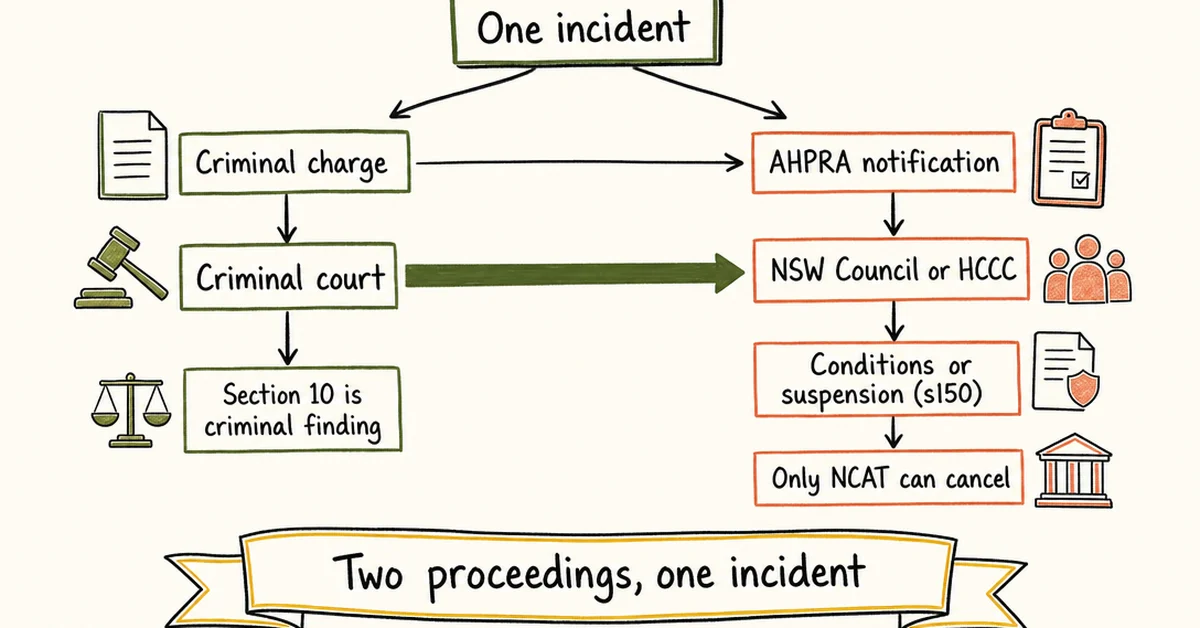
These are separate proceedings, they do not wait for each other, and the criminal outcome you would regard as a good one may not close the regulatory question. Four mechanisms drive that.
- The charge itself is reportable. Where the offence is a scheduled medicine offence, or carries 12 months imprisonment or more, s130 requires notice within 7 days of being charged, long before the matter is finalised, and it becomes a complaint (s139I).
- The court reports you, whether or not you do. Under s151A a NSW court that convicts a person, or makes a criminal finding against them for a sex or violence offence or a drug related offence, must notify the relevant Council along with the penalty, where the court has reasonable grounds to believe the person is or was registered. Section 151A(3) then provides that “a complaint is taken to have been made to a Council”.
- A non-conviction order does not necessarily end it. “Criminal finding” is defined in s138 to include an offence proved without proceeding to a conviction, and a discharge or conditional release on a good behaviour bond after such a finding. So a section 10 non-conviction order, often the right objective in the criminal court, still leaves a criminal finding that can found a complaint under s144(a), and still triggers the court’s duty to notify.
- The regulator does not wait for the court. Section 145G provides that a complaint can be referred to a Committee or the Tribunal, and dealt with by them, “even though the practitioner … is the subject of proposed or current criminal or civil proceedings relating to the subject-matter” of the complaint.
The forums ask different questions. The criminal court asks whether the offence is proved beyond reasonable doubt. NCAT asks, under s149C(1)(c), whether the circumstances of the offence render you unfit in the public interest to practise your profession.
A modest criminal penalty can still end a career, and conduct the criminal court never reaches can still be professional misconduct (s139E).
One further trap: an Assessment Committee, which hears matters for professions other than medicine and nursing and midwifery, cannot deal with a complaint of conviction or criminal finding (s147A(2)), so a criminal matter goes to a more serious forum by default.
So the plea, the agreed facts and anything said during police questioning all need to be handled with the regulator in mind.
What are the possible outcomes?
Most complaints end without action against the practitioner, and only NCAT can cancel registration. The NSW Councils received 6,370 complaints in 2024/25, about 1.90% of registered practitioners. Across the 5,508 outcomes recorded for complaints closed that year:
| Outcome | Share of recorded outcomes |
|---|---|
| Discontinued | 69.6% |
| No further action | 11% |
| Conditions imposed or by consent (254 complaints) | 4.6% |
| Cancellation, suspension or surrender of registration | 2% |
Source: Health Professional Councils of NSW Annual Report 2024/25, Table 13. That year 37 hearings were referred to NCAT and 63 closed.
Can you appeal, and where does NCAT fit?
Yes, by two routes with different tests, and the deadline that matters is 28 days.
Review by the Council (s150A). You can ask the Council to reconsider a s150 suspension or the conditions imposed. Under s150A(4) it may vary or set aside its decision only if satisfied your circumstances have changed, so a review suits a situation that has genuinely moved, such as completed treatment, not an argument that the decision was wrong.
Appeal to NCAT (s159). You may appeal against a Council reprimand, a suspension or refusal to end one, and against conditions imposed or altered. Appeals against a Committee’s finding are under s158 and are heard as a rehearing, which means fresh evidence can be considered. Section 161 requires the appeal within 28 days of written notice of the reasons, unless NCAT allows longer, and that limit does not apply to an appeal on a point of law.
Under s161B an appeal does not stay the decision unless the Tribunal orders otherwise, so a suspension keeps biting while it runs. Representation differs by forum: it is permitted before NCAT (s165J) and at a Professional Standards Committee inquiry (s171B), but s147E provides that you are not entitled to legal representation before an Assessment Committee.
Your rights and what you can do now
Remember, you have real rights, and the first few weeks shape everything after. The most valuable thing you can do is slow down before writing anything.
Your rights: to written notice of the complaint and, for s150 action, of the decision and its reasons; to respond in writing, with 28 days for submissions where the HCCC proposes certain action after an investigation (s40 HCC Act); to Council review (s150A) and appeal to NCAT (s159); and to representation before NCAT and a Professional Standards Committee.
Practical steps:
- Do not send a detailed written explanation before it has been reviewed. Your response is evidence, and this is the most common way a manageable matter becomes a serious one.
- Diarise the deadlines: 7 days for a s130 self-report, 28 days for submissions, 28 days for an NCAT appeal. A late self-report is its own ground for action, and reads worse than the underlying event.
- Preserve the records. Clinical notes, rosters, incident reports and messages are often the answer to a performance complaint, and they get overwritten.
- Deal with the underlying issue where there is one. Treatment or training counts for more when you started it before you were told to.
How a lawyer could help your AHPRA notification
The work is not only defending an allegation. It is controlling what goes on the file, meeting the deadlines, and making sure one forum’s decision does not damage you in the other:
- Getting the first response right, so it answers the regulatory question (risk to the public, insight, remediation) and concedes nothing that matters elsewhere.
- Responding to immediate action, by putting your position before the Council makes a s150 order, then advising whether the path is a s150A review, an NCAT appeal, or negotiated conditions you can work under.
- Managing the interaction with a criminal charge, so the plea, the agreed facts and the sentencing material are settled with s149C and s151A in view.
- Testing whether the complaint is made out, and preparing for any hearing before a Professional Standards Committee or NCAT.
Every matter turns on its own facts, and no lawyer can promise a particular outcome. Early advice prevents avoidable damage in the weeks when most of it happens.
Frequently asked questions
Who handles AHPRA notifications in NSW?
Your NSW Council and the HCCC, not AHPRA. Section 6 of the Adoption Act declares that NSW does not participate in the National Law’s health, performance and conduct process. AHPRA still handles registration and receives mandatory notifications and s130 self-reports, which it passes to NSW.
Can a notification be made anonymously?
Usually, yes. Ahpra accepts anonymous notifications, although a mandatory notification cannot be made anonymously. If the Commission gives you notice of a complaint, that notice must state the nature of the complaint and the identity of the complainant (s16(1), Health Care Complaints Act 1993). The Commission can withhold notice where giving it would prejudice the investigation or put someone at risk of harm or intimidation (s16(4)).
How long does an AHPRA notification take in NSW?
Usually months. The HCCC must assess within 60 days (average 45 days in 2024/25), but there is no limit on an investigation, which averaged 267 days that year.
Do I have to tell AHPRA if I have been charged with an offence?
Yes, if it is a scheduled medicine offence or is punishable by 12 months imprisonment or more. Section 130 requires written notice to your National Board within 7 days, at the charge stage, not after the matter is finalised. Conviction or a finding of guilt for a scheduled medicine offence, or for any offence punishable by imprisonment, is also reportable.
Will a section 10 non-conviction order keep the Council out of it?
Not necessarily. “Criminal finding” is defined in s138 to include an offence proved without proceeding to conviction, and a discharge or conditional release on a good behaviour bond after such a finding. That is a ground of complaint under s144(a), and under s151A a court that has reasonable grounds to believe you are registered must still notify the Council for a sex, violence or drug offence.
Will the notification appear on the public register?
Not the notification itself. The register shows registration status and current conditions or undertakings, and Council conditions are published there unless they are health related. A selection of NCAT decisions, chosen as being of public interest, is published on the NSW Caselaw website.
How O’Brien Criminal & Civil Solicitors can help
If you have been reported and charged, you face two processes at once, and the one that decides your career is usually not the one in the courtroom. O’Brien Criminal & Civil Solicitors is a leading Sydney criminal defence firm, led by an Accredited Specialist in Criminal Law (held by fewer than 6% of NSW solicitors), with more than 20 years acting for professionals whose registration is at stake.
We act on the charge and manage the regulatory exposure alongside it: meeting your s130 obligations on time, drafting your response to the Council or the HCCC with the regulatory test in mind, and settling the plea and sentencing material with s149C and s151A in view. For the wider picture, see our professional misconduct page.
Request initial advice (no-obligation) via the form below or call us on (02) 9261 4281.
This content is for general information purposes only and does not constitute legal advice. You should seek independent legal advice relevant to your specific circumstances.
Health practitioner complaints and notifications in NSW: What happens when you are reported, and what to do